Failed intubation drill in obstetric general anaesthesia
Obstetric airway · Perioperative & Anaesthesia
Physician-written · Verified by three sets of doctors · Reviewed November 2026
Bedside summary
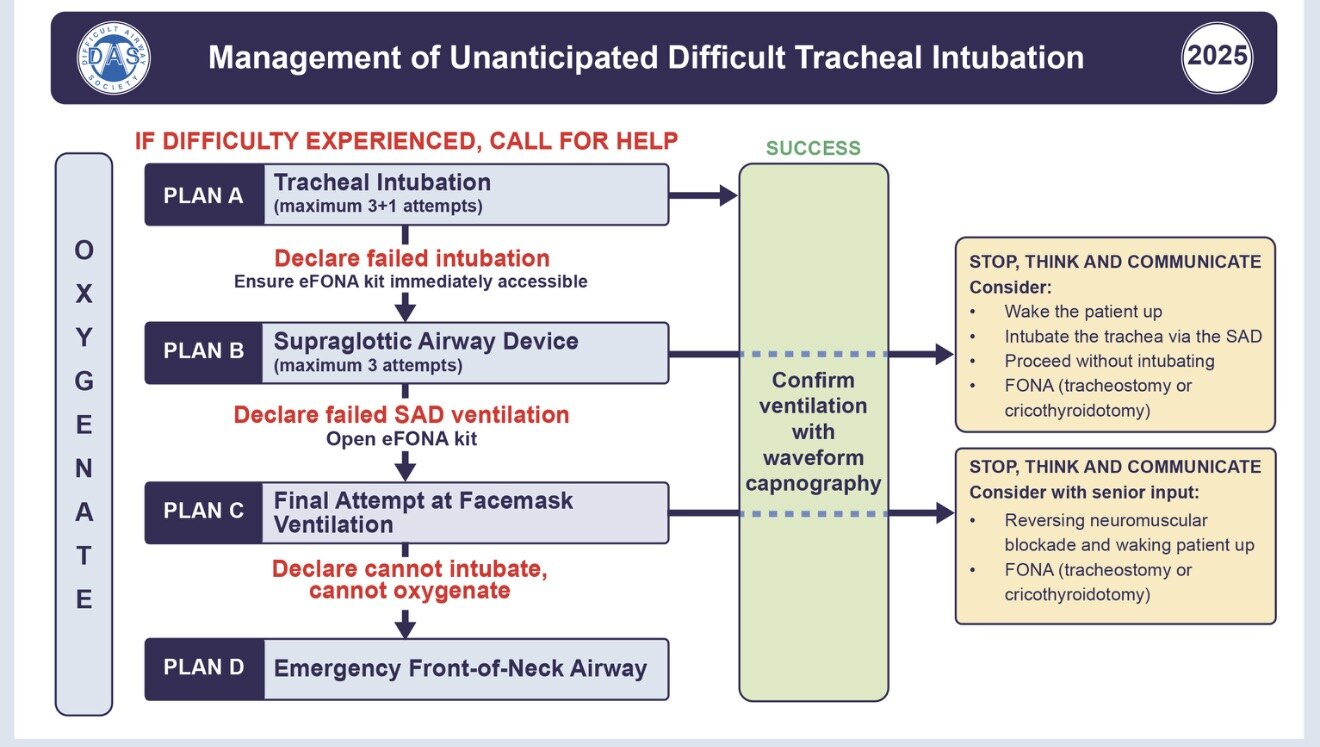
Failed tracheal intubation at obstetric general anaesthesia is more common than in the general population due to airway oedema, weight gain, breast enlargement and rapid desaturation; the OAA/DAS algorithm prioritises maternal oxygenation and a structured decision on whether to wake or proceed.
Figures & algorithms
Red flags
- Rapid maternal desaturation despite optimised ventilation
- Soiling of the airway / witnessed regurgitation
- Inability to ventilate via mask or SGA (impending CICO)
- Fetal bradycardia increasing pressure to proceed unsafely
- Repeated intubation attempts worsening airway oedema and bleeding
Assessment
Differential diagnosis
- Airway oedema of pregnancy / pre-eclampsia reducing glottic view
- Rapid desaturation from reduced FRC and increased oxygen consumption
- Full stomach and high aspiration risk
- Difficult laryngoscopy from weight gain and breast tissue
- Cricoid pressure worsening the view
- Equipment or operator inexperience under time pressure
Investigations
- Continuous waveform capnography (primary confirmation of ventilation/intubation)
- SpO2 and the rate of desaturation
- Laryngoscopic grade and assessment of mask/SGA ventilation
- Fetal heart rate monitoring to inform urgency
- Assessment of aspiration (soiling, gastric contents)
- Pre-induction airway assessment and aspiration-prophylaxis status
Management
- Declare failed intubation after a maximum of 2 laryngoscopy attempts (3rd only by a senior/expert)
- Optimise each attempt: videolaryngoscopy, external laryngeal manipulation, bougie, reduce/remove cricoid if it impairs view
- Call for senior anaesthetic help and the difficult airway trolley immediately
- Maintain oxygenation with 2-person face-mask ventilation using adjuncts
- Insert a second-generation supraglottic airway (max 2 attempts) if mask ventilation inadequate
- Make the wake-or-proceed decision using maternal and fetal factors, aspiration risk and airway feasibility
- If oxygenation maintained and surgery urgent/essential, proceed via SGA with care and senior input
- If oxygenation cannot be maintained, declare CICO and perform front-of-neck access without delay
- Maintain cricoid pressure unless it impairs ventilation/intubation, then release
- Keep the patient in left lateral tilt / manage aortocaval compression throughout
- Prevent and be ready to treat aspiration; have suction immediately available
- Debrief, document and arrange follow-up; inform the obstetric team of airway findings
Drugs & doses
Suxamethonium 1–1.5 mg/kg IV for RSI (short duration aids return of spontaneous ventilation if waking)
Rocuronium 1–1.2 mg/kg IV as alternative RSI relaxant (reversible with sugammadex)
Sugammadex 16 mg/kg IV for immediate rocuronium reversal if waking the patient
Propofol 2–2.5 mg/kg IV or thiopental 5–7 mg/kg IV for induction
Phenylephrine 50–100 micrograms IV / ephedrine 3–6 mg IV for maternal hypotension
Oxytocin 5 units IV slowly after delivery (avoid bolus in cardiovascular instability)
Disposition
Recovery in a high-dependency obstetric area or ICU depending on oxygenation and aspiration; senior obstetric anaesthetist to review, document airway and flag for future care.
Complications & pitfalls
- Maternal hypoxia and hypoxic brain injury
- Aspiration pneumonitis
- Airway trauma, oedema and bleeding
- Awareness if anaesthesia lightened while waking
- Emergency front-of-neck access and its sequelae
Exam pearls
- Prioritise maternal oxygenation over securing the tube — 'mother first'
- Decide wake-or-proceed early; indecision is dangerous
- Second-generation SGAs provide better aspiration protection and a conduit for intubation
- Videolaryngoscopy should be immediately available for all obstetric GA
- Give effective aspiration prophylaxis (antacid + ranitidine/PPI + prokinetic) whenever time allows
Disclaimer: Educational decision support for qualified clinicians and students — not a substitute for clinical judgement, local protocols or a full drug reference. Confirm every dose and contraindication against your formulary before prescribing.