Unanticipated difficult tracheal intubation (DAS 2025 guideline)
Bedside summary
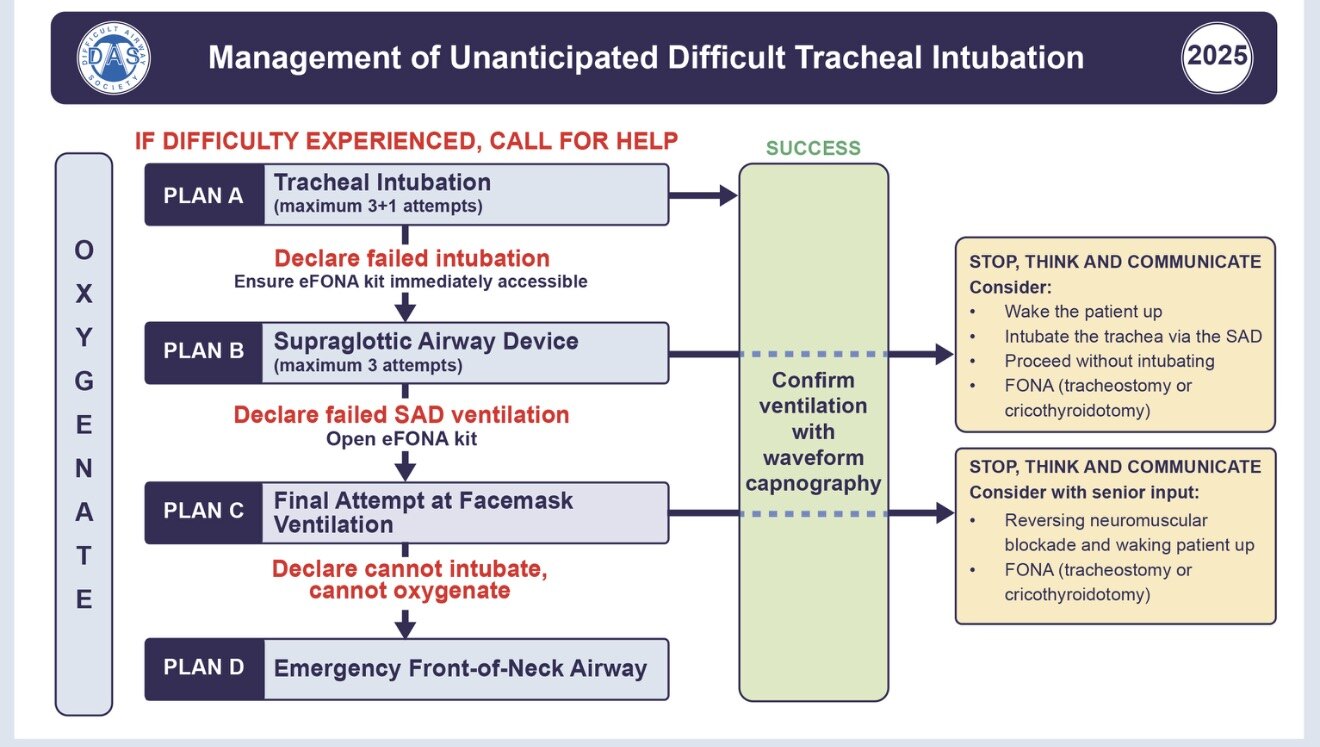
The Difficult Airway Society (DAS) 2025 algorithm for unanticipated difficult tracheal intubation in adults. The priority throughout is OXYGENATION, not intubation: progress through Plan A (intubation), Plan B (supraglottic airway), Plan C (final facemask ventilation) and Plan D (emergency front-of-neck airway), declaring failure aloud at each step and moving on without fixation. Call for help early, verify every airway with waveform capnography, and commit to scalpel–bougie eFONA the moment cannot-intubate-cannot-oxygenate (CICO) is declared.
Figures & algorithms
Red flags
- Falling SpO2 despite optimised intubation, SAD and facemask attempts — declare CICO and cut
- Absent capnography trace with no chest rise — ventilation is not occurring
- Repeated laryngoscopy beyond 3 + 1 attempts — fixation that delays rescue oxygenation
- Impalpable neck landmarks (obesity, haematoma, radiotherapy) — anticipate a vertical-incision eFONA
- Neuromuscular blockade allowed to wear off mid-crisis — worsens both ventilation and FONA conditions
Assessment
Differential diagnosis
- Unanticipated difficult laryngoscopy / failed intubation
- Difficult or failed facemask ventilation
- Difficult or failed supraglottic airway ventilation
- Cannot intubate, cannot oxygenate (CICO) — the eFONA trigger
- Anticipated difficult airway (manage pre-emptively — awake tracheal intubation pathway)
- Laryngospasm, soiling, airway oedema or distorting pathology as the cause
Investigations
- Continuous waveform capnography — the single confirmatory monitor at every plan
- Continuous SpO2, ECG and blood pressure; time awareness (count attempts aloud)
- Cormack–Lehane / videolaryngoscopy view grade at each attempt
- Pre-induction airway assessment incl. cricothyroid membrane and aspiration risk
- Point-of-care gastric ultrasound where aspiration risk is uncertain
- Post-event ABG, chest X-ray and flexible scope to confirm tube position
Management
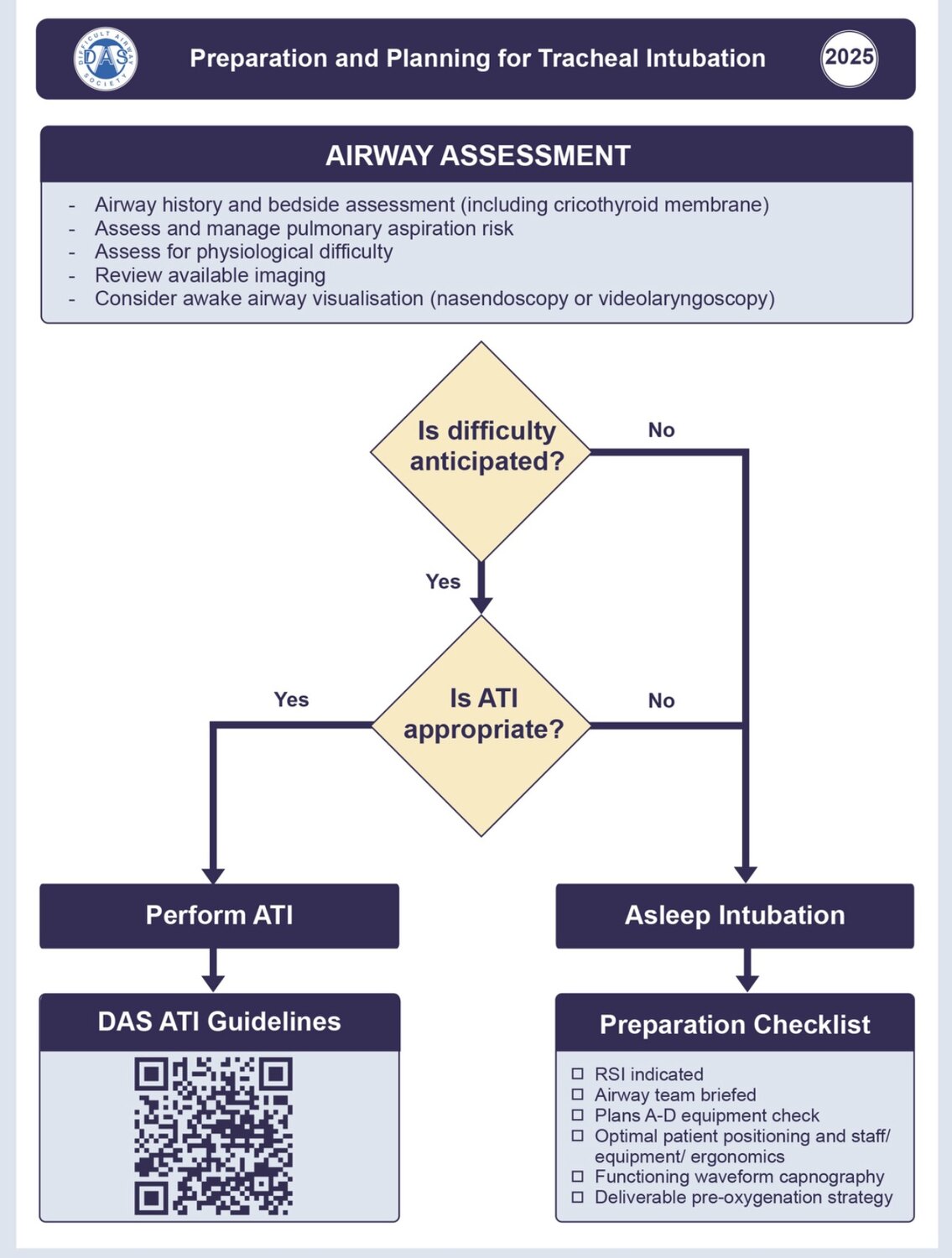
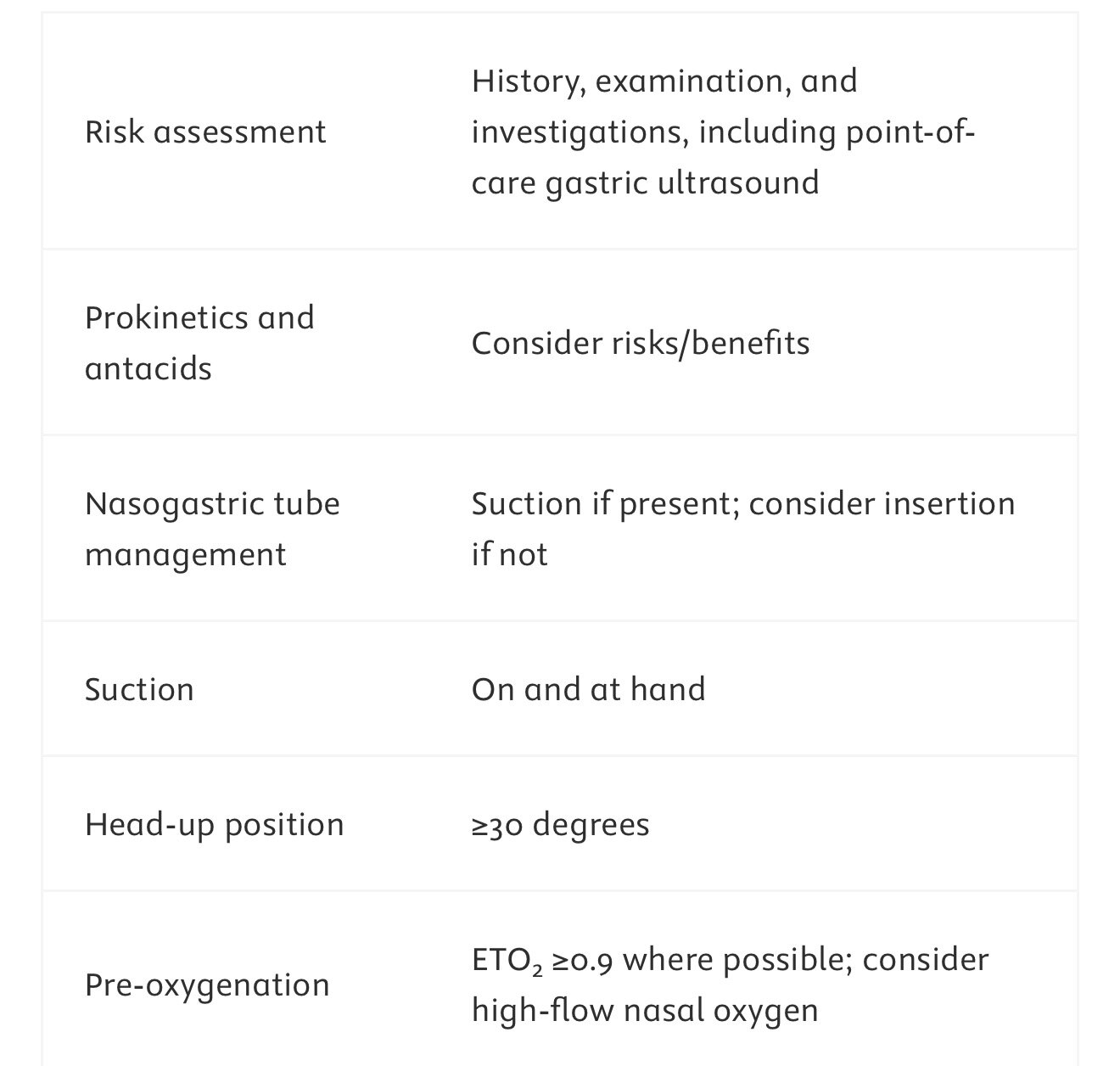
- PREPARATION: airway assessment (history + bedside incl. cricothyroid membrane, aspiration risk, physiological difficulty, imaging); if difficulty anticipated and ATI appropriate → awake tracheal intubation; otherwise brief the team and run the Plans A–D equipment/pre-oxygenation checklist.
- IF DIFFICULTY EXPERIENCED, CALL FOR HELP — and ensure the eFONA kit is immediately accessible.
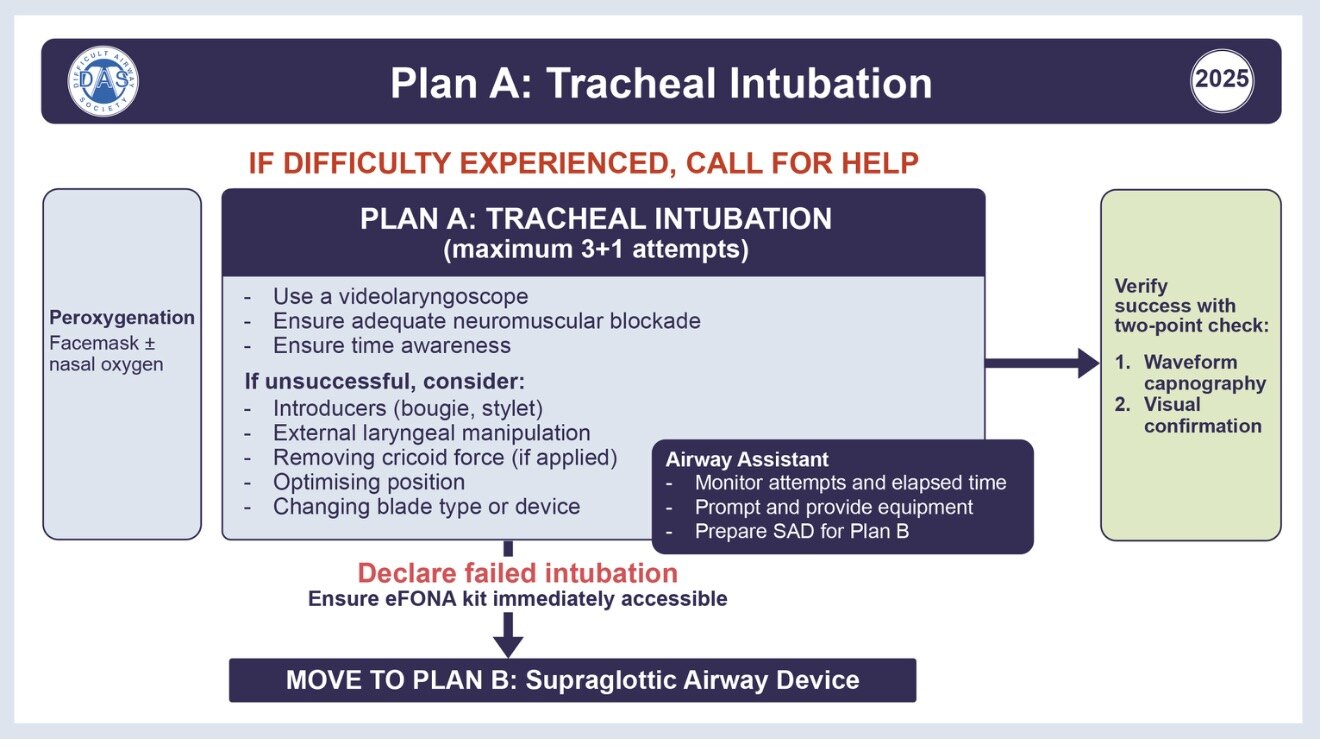
- PLAN A — Tracheal intubation (maximum 3 + 1 attempts): pre-oxygenate (facemask ± nasal oxygen), use a videolaryngoscope, ensure adequate neuromuscular blockade and time awareness. If unsuccessful consider: introducers (bougie/stylet), external laryngeal manipulation, removing cricoid force, optimising position, changing blade type or device.
- Verify tube success with a two-point check: waveform capnography AND visual confirmation. If this fails, DECLARE FAILED INTUBATION, ensure the eFONA kit is accessible, and move to Plan B.
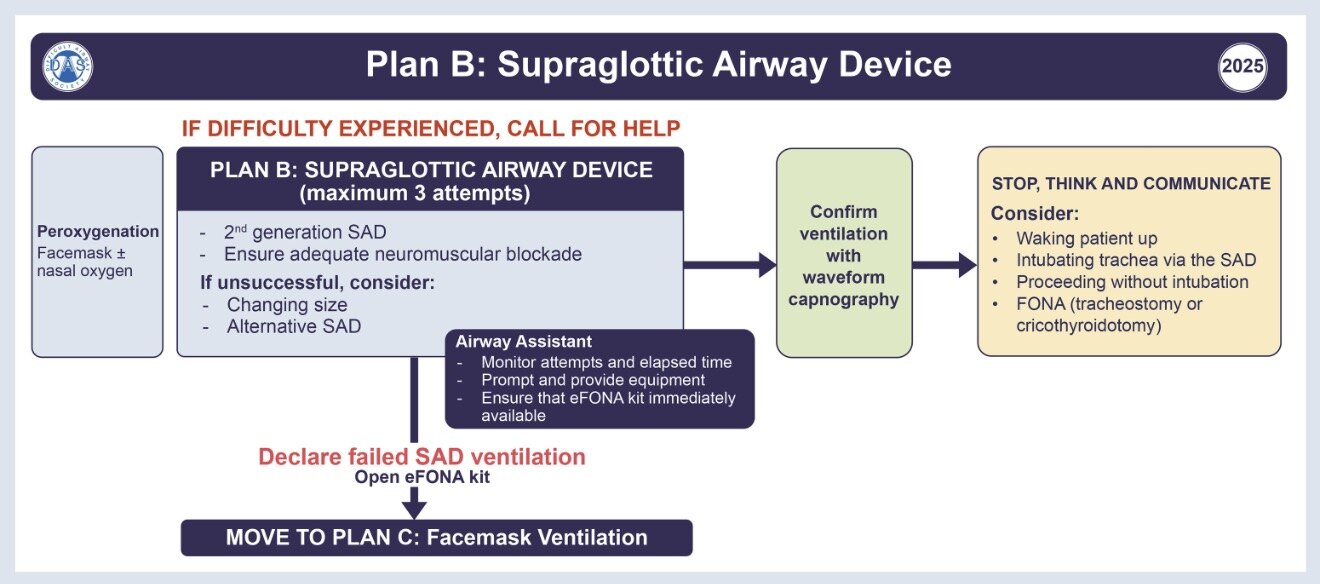
- PLAN B — Supraglottic airway device (maximum 3 attempts): insert a 2nd-generation SAD with adequate neuromuscular blockade; if unsuccessful consider changing size or an alternative SAD. Confirm ventilation with waveform capnography.
- If the SAD ventilates: STOP, THINK, COMMUNICATE — consider waking the patient, intubating the trachea via the SAD, proceeding without intubating, or FONA (tracheostomy/cricothyroidotomy). If it fails, DECLARE FAILED SAD VENTILATION, open the eFONA kit, and move to Plan C.
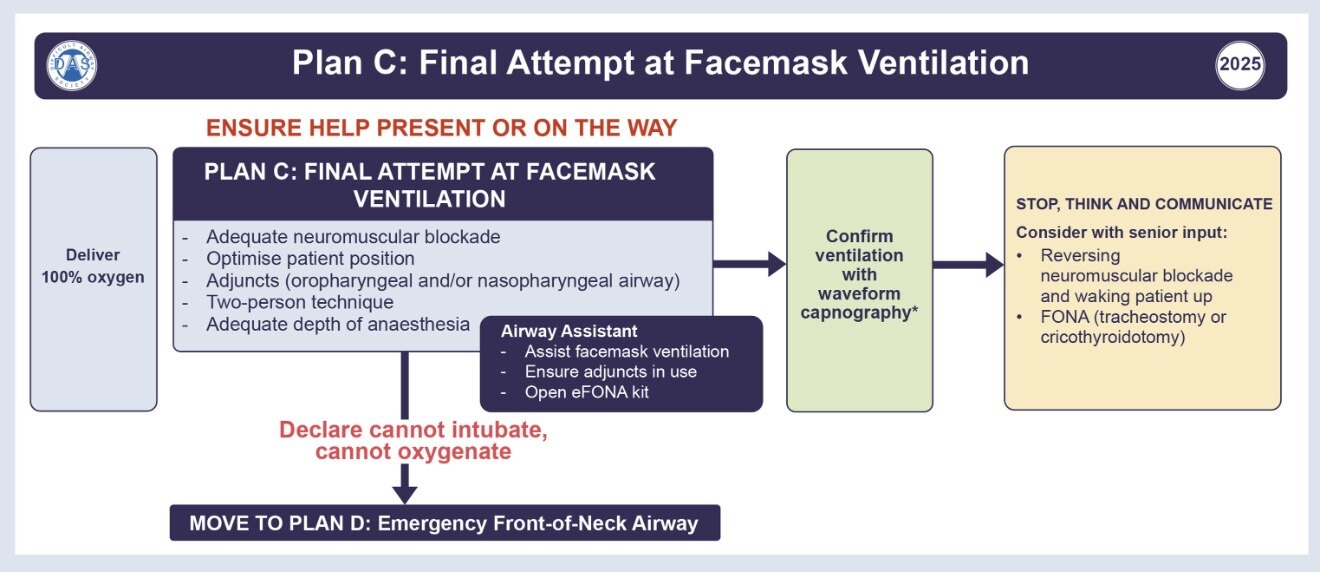
- PLAN C — Final attempt at facemask ventilation: deliver 100% oxygen; ensure adequate neuromuscular blockade and depth of anaesthesia; optimise position; use oro-/nasopharyngeal adjuncts and a two-person technique. Confirm ventilation with waveform capnography.
- If Plan C ventilates: STOP, THINK, COMMUNICATE with senior input — consider reversing neuromuscular blockade and waking the patient, or FONA. If it fails, DECLARE CANNOT INTUBATE, CANNOT OXYGENATE (CICO) and move immediately to Plan D.
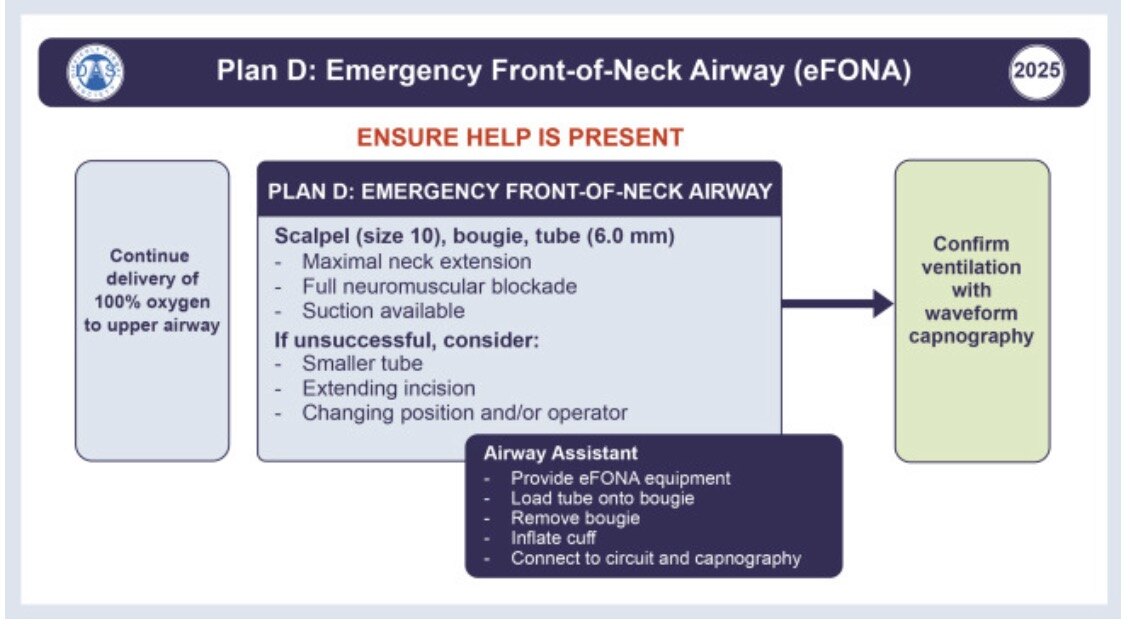
- PLAN D — Emergency front-of-neck airway (eFONA): ensure help is present, continue delivering 100% oxygen to the upper airway, and perform a scalpel–bougie–tube cricothyroidotomy with full neuromuscular blockade and suction available.
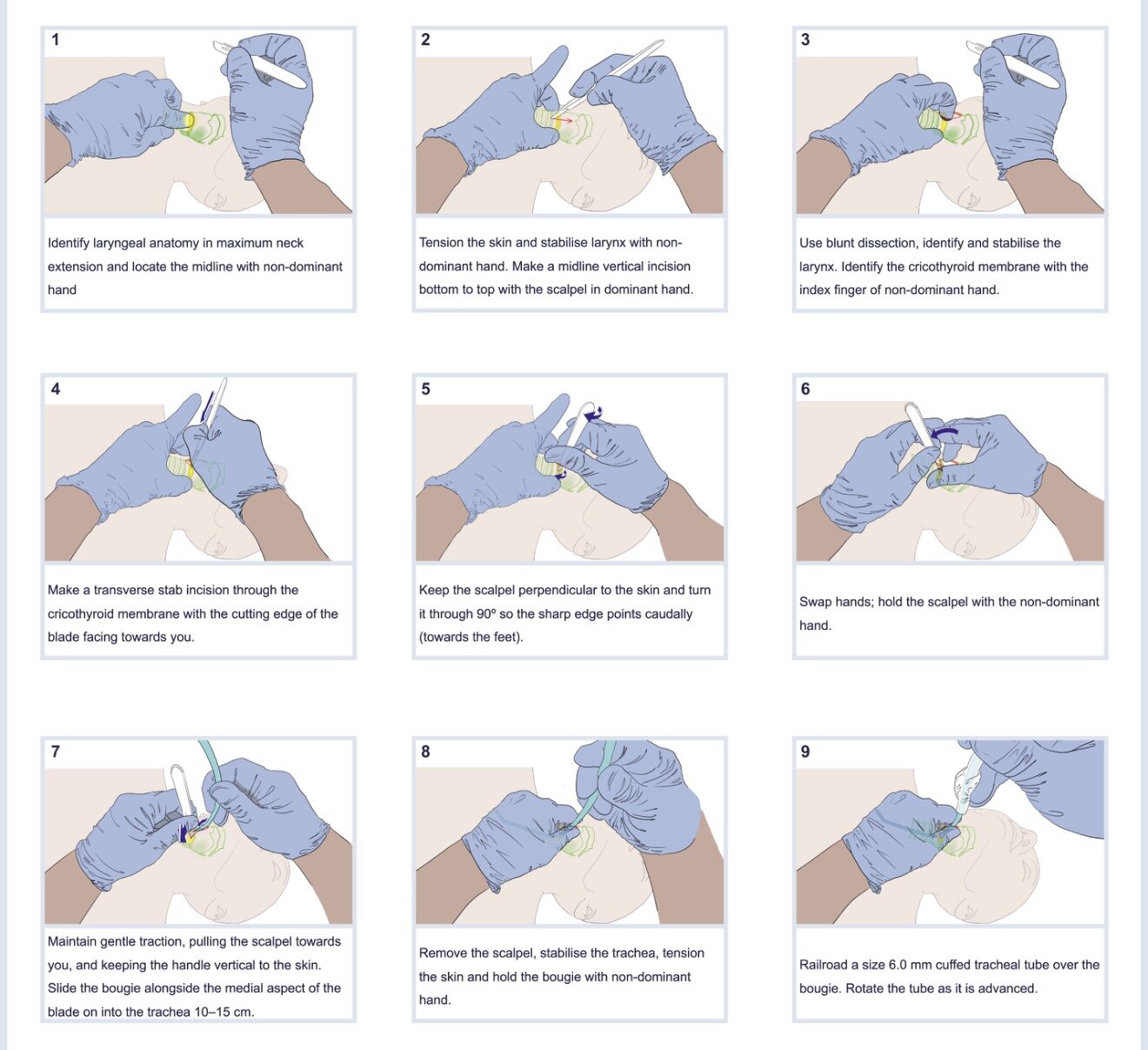
- eFONA technique (scalpel size 10, bougie, 6.0 mm cuffed tube): 1) maximal neck extension, locate the midline; 2) stabilise the larynx, midline vertical skin incision; 3) blunt dissection, identify the cricothyroid membrane with the finger; 4) transverse stab through the membrane; 5) rotate the blade 90° (sharp edge caudal); 6) swap the scalpel to the non-dominant hand.
- eFONA technique (continued): 7) slide the bougie alongside the blade into the trachea 10–15 cm; 8) remove the scalpel and stabilise the trachea; 9) railroad the 6.0 mm cuffed tube over the bougie, inflate the cuff. If unsuccessful consider a smaller tube, extending the incision, or changing position/operator.
- Confirm final placement with waveform capnography, hand-ventilate, summon ENT/surgical airway support, then admit to critical care and complete airway follow-up, documentation and debrief.
Drugs & doses
Disposition
Complications & pitfalls
- Hypoxic brain injury or death from delayed front-of-neck access
- Aspiration of gastric contents
- Haemorrhage, tube malposition (pretracheal/oesophageal) or posterior tracheal injury at eFONA
- Surgical emphysema, pneumothorax and later subglottic stenosis
- Airway trauma and dental damage from repeated laryngoscopy
Exam pearls
- Oxygenation is the goal, not intubation — declare failure aloud and move to the next plan without fixation
- Waveform capnography confirms the airway at EVERY plan — a trace is the arbiter of success
- Maximum attempts are capped: Plan A 3 + 1, Plan B 3 — counting attempts out loud prevents task fixation
- Keep full neuromuscular blockade throughout; a paralysed patient is easier to ventilate AND to perform eFONA on
- One standardised scalpel–bougie technique (size 10 blade, bougie, 6.0 tube) reduces cognitive load in the CICO crisis
- Prepare for the airway you have: assess the cricothyroid membrane and aspiration risk before induction, every time
Adapted for quick bedside reference from the Difficult Airway Society (DAS) 2025 guideline for the management of unanticipated difficult tracheal intubation in adults. Figures © Difficult Airway Society 2025. Educational use only — follow your local difficult-airway protocol and training.
Disclaimer: Educational decision support for qualified clinicians and students — not a substitute for clinical judgement, local protocols or a full drug reference. Confirm every dose and contraindication against your formulary before prescribing.