CABG in acute STEMI — indications & timing
Bedside summary
Coronary artery bypass grafting is used in only about 5% or fewer of STEMI cases because PCI and fibrinolysis restore flow far faster. It is reserved for defined subgroups: failed or complicated PCI with ongoing ischaemia and suitable anatomy; mechanical complications of MI; left main or severe multivessel disease (especially with shock, poor LV function or diabetes); life-threatening ventricular arrhythmia; and late presenters or recurrent ischaemia not amenable to PCI. The decision is a heart-team one, and timing depends heavily on the indication.
Figures & algorithms
Red flags
- Mechanical complication (free-wall/septal rupture, papillary muscle rupture) — near-100% mortality with medical therapy alone
- Cardiogenic shock
- Life-threatening ventricular arrhythmia
- Ongoing ischaemia not amenable to PCI
Assessment
Differential diagnosis
- Primary PCI of the culprit artery (preferred reperfusion in most cases — faster than CABG)
- Fibrinolysis where timely PCI is unavailable
- PCI of culprit + staged/elective CABG for residual disease
- Hybrid CABG–PCI (LIMA to LAD plus PCI of other vessels)
- Medical therapy alone where anatomy is unsuitable and no emergency indication exists
Investigations
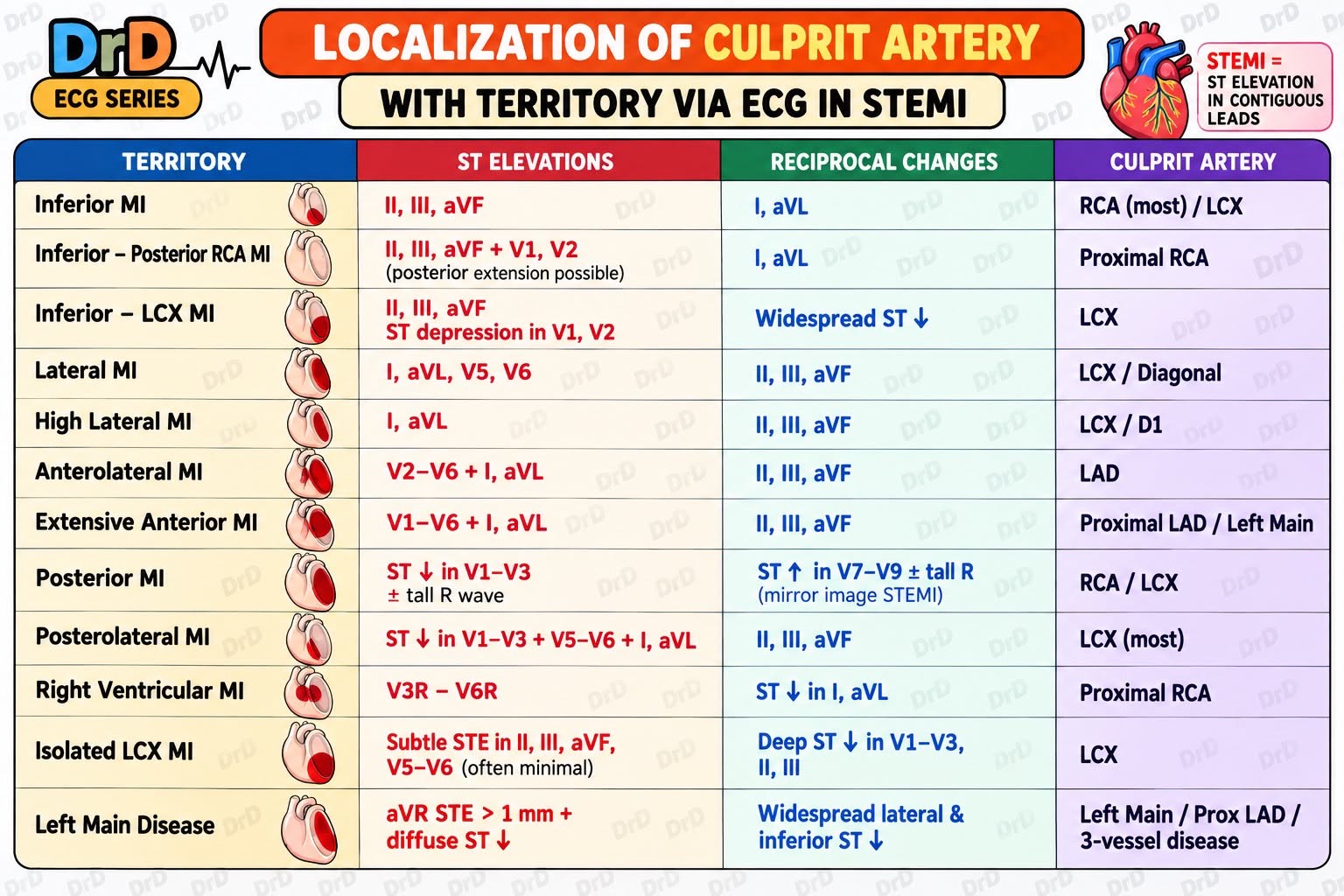
- Coronary angiography — defines left main/multivessel disease and graftable targets
- Echocardiography — mechanical complications, LV function, mitral regurgitation
- ECG and clinical assessment for ongoing ischaemia
- Heart-team (interventional cardiology + cardiac surgery) review
Management
- For ongoing ischaemia after unsuccessful/complicated PCI with suitable anatomy, favour urgent/emergency CABG over medical therapy alone.
- For a mechanical complication, prefer immediate CABG with repair of the defect rather than PCI followed by later surgery.
- For left main / severe three-vessel disease that is unstable, make an individualised heart-team decision; PCI of the culprit is reasonable if distal flow is abnormal and PCI is faster/safer.
- Operate emergently (ongoing ischaemia, shock, PCI failure, mechanical complication); aim to complete bypass within ~12 hours of symptom onset in those operated within 6 hours.
- For stable patients without an emergency indication, defer surgery to day 3 or later (early surgery after STEMI raises mortality/morbidity).
- For recurrent/inducible ischaemia with multivessel disease, CABG within 48 hours is a reasonable strategy.
Drugs & doses
Disposition
Complications & pitfalls
- Higher peri-operative mortality when operated very early after STEMI or soon after fibrinolysis
- Major haemorrhage (greatest with recent lytic and/or dual antiplatelet loading)
- Peri-operative MI, stroke and low-cardiac-output state
- Death
Exam pearls
- PCI is preferred to CABG after failed fibrinolysis: in the TIMI II analysis, surgery within 24 h of the lytic carried higher mortality (17% vs 4%) and major haemorrhage (74% vs 51%).
- Stable patients without an emergency indication should be deferred to day 3+ — the first 48 hours after STEMI is associated with increased mortality/morbidity.
- In unstable patients venous conduits are often preferred for speed and to deliver cardioplegia and control reperfusion; on-pump is preferred for most.
- For a mechanical complication, immediate CABG plus defect repair is preferred to PCI-first, because relieving ischaemia does not reverse the haemodynamic impact of the defect.
- Factors favouring emergency CABG: large ischaemic territory, good general health, bypassable vessels, ability to operate within ~6 hours, and life-threatening VT; a no-reflow state and small myocardium at risk argue against it.
CABG is for the minority — mechanical complications, failed or unsuitable PCI, and left main / complex anatomy; the antiplatelet load from PCI complicates the timing of surgery.
Disclaimer: Educational decision support for qualified clinicians and students — not a substitute for clinical judgement, local protocols or a full drug reference. Confirm every dose and contraindication against your formulary before prescribing.