Congenital complete (third-degree) AV block
Bradyarrhythmia · Cardiac
Physician-written · Verified by three sets of doctors · Reviewed November 2026
Bedside summary
Complete AV dissociation present from fetal/neonatal life or found in a child/young adult, most often from maternal anti-Ro/La antibodies (neonatal lupus) or congenital heart disease. A junctional/ventricular escape maintains output; the risk is a slow or unreliable escape causing heart failure, syncope (Stokes-Adams) or sudden death.
Figures & algorithms
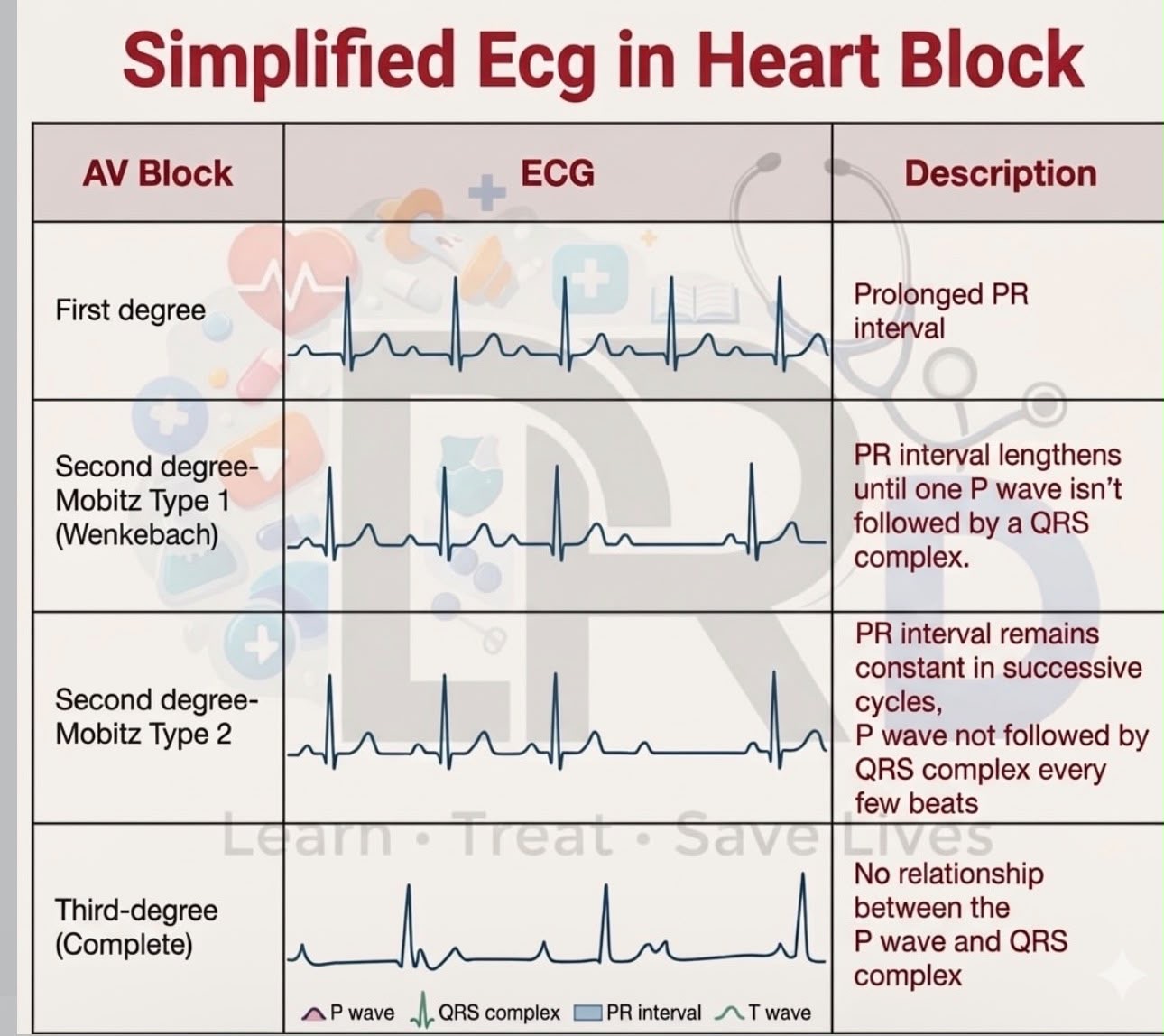
Red flags
- Syncope / Stokes-Adams attacks
- Wide-complex or very slow (<50) escape, or long ventricular pauses
- Heart failure or impaired ventricular function
- Failure of the rate to rise with exercise
Assessment
Investigations
- 12-lead ECG (AV dissociation; assess escape rate and QRS width — narrow junctional escape is more reliable than a wide ventricular one)
- Echo for structural CHD and ventricular function
- Maternal/own anti-Ro (SSA) / anti-La (SSB) antibodies
- Holter / exercise testing to judge escape reliability
Management
- Assess perfusion and the escape rhythm; unstable (shock, heart failure, syncope) → resuscitate and arrange temporary pacing
- A WIDE-complex or very slow escape, exercise-related symptoms, or a long ventricular pause → high risk, admit and pace
- Chronotrope as a bridge to pacing if symptomatically bradycardic: isoprenaline infusion (atropine often ineffective in infranodal/congenital block)
- Definitive therapy is a PERMANENT PACEMAKER — indicated for symptoms, heart failure, wide escape, ventricular dysfunction, long pauses or an inadequate rate for age
- Involve paediatric/adult-congenital cardiology and EP
Drugs & doses
Isoprenaline infusion as a temporising chronotrope (titrate) — atropine is often ineffective
Temporary (transcutaneous → transvenous) pacing for the unstable patient
Disposition
Admit the unstable or high-risk patient for pacing; cardiology/EP (paediatric or adult-congenital) referral for pacemaker assessment.
Exam pearls
- A narrow junctional escape is usually more stable than a wide ventricular escape
- Most symptomatic congenital complete heart block ultimately needs a permanent pacemaker
- Ask about maternal connective-tissue disease / anti-Ro antibodies
Disclaimer: Educational decision support for qualified clinicians and students — not a substitute for clinical judgement, local protocols or a full drug reference. Confirm every dose and contraindication against your formulary before prescribing.