STEMI fibrinolysis — administration & agent selection
Bedside summary
Fibrinolysis is the reperfusion option for STEMI when timely primary PCI is not available, and works best given early (benefit falls with every minute of delay, generally within 12 h of symptom onset). It is always paired with loading antiplatelets and a parenteral anticoagulant, and in a pharmaco-invasive pathway is followed by angiography within 2–24 h regardless of apparent success. The feared complication is intracranial haemorrhage, so rigorous contraindication screening is essential.
Figures & algorithms
Red flags
- Absolute contraindications: prior intracranial haemorrhage, known cerebral vascular malformation or malignant intracranial tumour, ischaemic stroke within 3 months, suspected aortic dissection, active bleeding/bleeding diathesis, or significant closed-head/facial trauma within 3 months
- Sudden deterioration, severe headache, vomiting or abrupt BP rise after lysis — suspect intracranial haemorrhage
Assessment
Differential diagnosis
- Aortic dissection (absolute contraindication) — asymmetric pulses, tearing pain, widened mediastinum
- Acute pericarditis / myocarditis mimicking ST elevation
- Early repolarisation or LBBB mimicking STEMI
- Takotsubo (stress) cardiomyopathy
Investigations
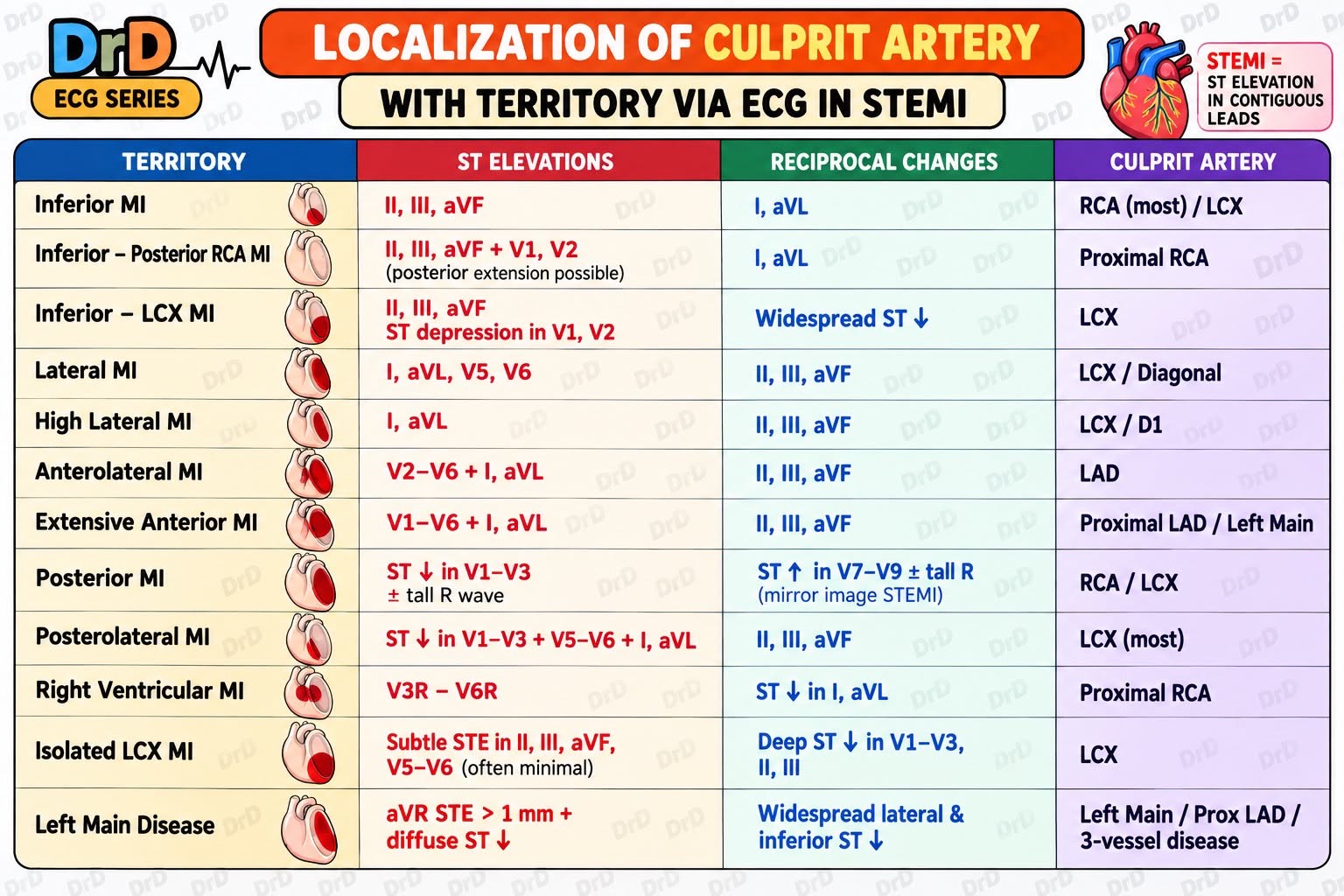
- 12-lead ECG — confirm STEMI; do not wait for troponin (diagnosis is clinical + ECG)
- FBC, U&E, coagulation screen, group & save — baseline bleeding assessment
- Body weight — required for weight-based fibrinolytic and anticoagulant dosing
- Chest radiograph if aortic dissection is suspected
Management
- Confirm STEMI on ECG and that timely primary PCI is unavailable
- Screen absolute and relative contraindications (bleeding / intracranial risk)
- Give loading aspirin + clopidogrel and a parenteral anticoagulant (UFH or enoxaparin)
- Administer the fibrinolytic as soon as possible (door-to-needle <30 min)
- Arrange transfer and angiography within 2–24 h regardless of response (pharmaco-invasive)
- Monitor for reperfusion, bleeding, reocclusion and arrhythmia
Drugs & doses
Disposition
Complications & pitfalls
- Intracranial haemorrhage (~0.7%) and ischaemic stroke (~1.2%)
- Severe bleeding ~1.8% (gastrointestinal tract the commonest spontaneous site)
- Failed reperfusion or reocclusion
- Reperfusion arrhythmias
Exam pearls
- Relative contraindications include SBP >180 mmHg (lower BP first), ischaemic stroke >3 months ago, prolonged/traumatic CPR >10 min or major surgery within 3 weeks, recent internal bleeding (2–4 weeks), a noncompressible puncture, current oral anticoagulation, pregnancy, active peptic ulcer, or an estimated ICH risk >4%.
- Door-to-needle time should be <30 min, ideally within 10 min of confirming STEMI on the ECG.
- Age alone is not a contraindication, and diabetic retinopathy should not be treated as one.
- Give angiography/PCI within 2–24 h after lysis regardless of apparent success; if not angiographed, perform stress or CT coronary imaging before discharge.
- ICH risk is raised by female sex, prior stroke, SBP ≥160, low body weight, and INR >4 or PT >24 s. TIMI 3 (complete) flow carries the mortality benefit (30-day mortality ~3.7% with TIMI 3 vs ~8.8% with TIMI 0–1).
Fibrinolysis is the fallback when timely primary PCI is unavailable — give it fast, screen rigorously for bleeding/intracranial risk, and still plan early angiography.
Disclaimer: Educational decision support for qualified clinicians and students — not a substitute for clinical judgement, local protocols or a full drug reference. Confirm every dose and contraindication against your formulary before prescribing.