Angioedema of the upper airway — ENT airway management
Bedside summary
Rapid swelling of the lips, tongue, floor of mouth, pharynx or larynx that threatens the airway. The two broad mechanisms differ in treatment: HISTAMINERGIC/allergic (anaphylactic) angioedema responds to ADRENALINE, antihistamines and steroids, whereas BRADYKININ-mediated angioedema (ACE-inhibitor or hereditary/acquired C1-inhibitor deficiency) does NOT respond to adrenaline/steroids and needs specific agents. From the ENT standpoint, assess the airway (flexible nasendoscopy) and plan an early, controlled, senior-led airway.
Figures & algorithms
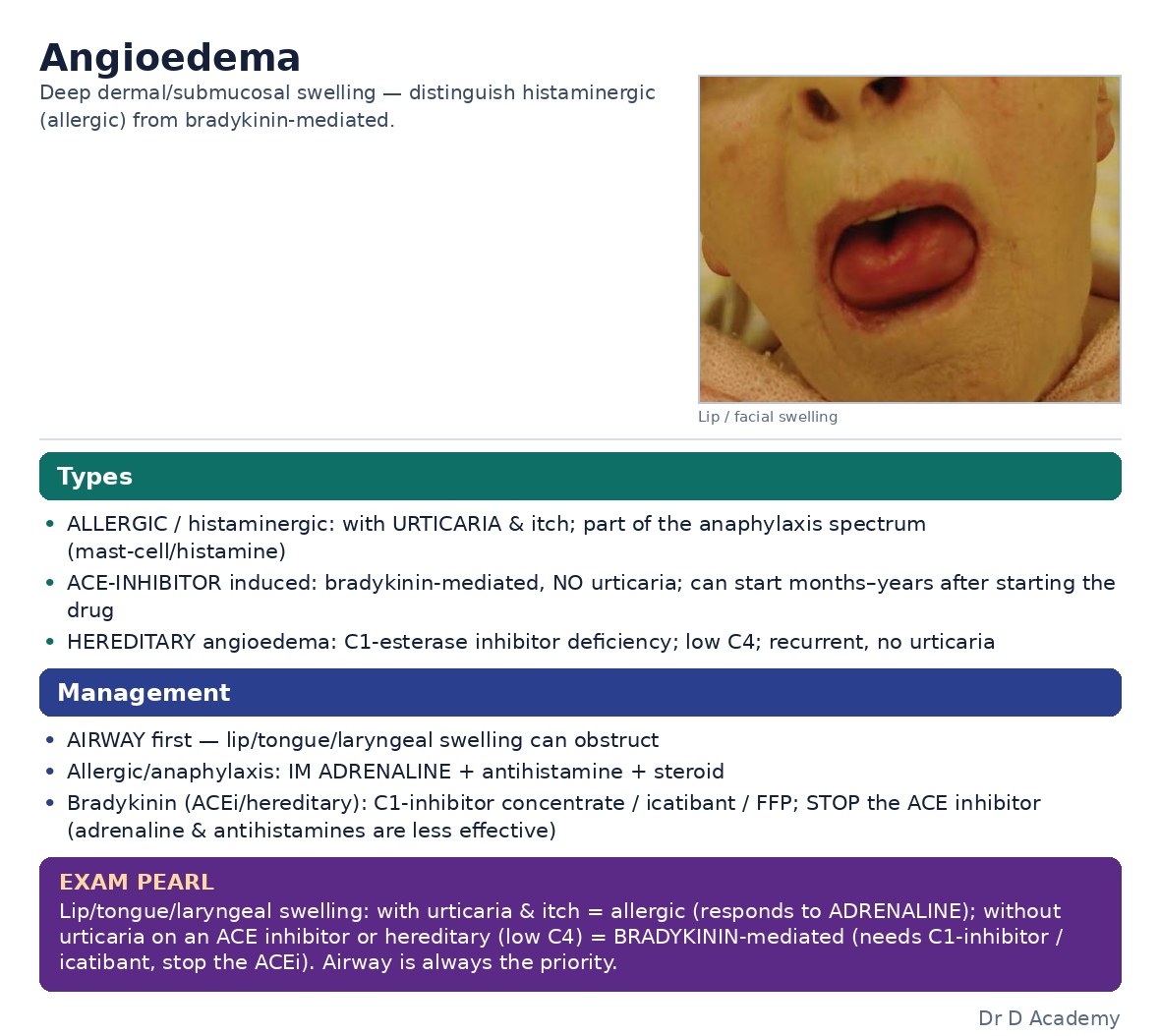
Red flags
- Tongue/floor-of-mouth or laryngeal swelling, voice change, drooling or stridor
- Rapid progression
- Angioedema without urticaria on an ACE inhibitor or with a family history (bradykinin-mediated — adrenaline/steroids will not work)
- Any airway compromise
Assessment
Differential diagnosis
- Histaminergic/allergic (anaphylaxis) — urticaria, itch, wheeze, hypotension; responds to adrenaline
- ACE-inhibitor-induced angioedema — often tongue/lips/floor of mouth, no urticaria, may start years into therapy
- Hereditary/acquired C1-inhibitor deficiency (bradykinin-mediated) — recurrent, family history, no urticaria
Investigations
- Flexible nasendoscopy to assess supraglottic/laryngeal involvement — by a clinician able to secure the airway
- Clinical distinction (urticaria/itch vs none; drug history of ACE inhibitor; prior episodes/family history)
- Serum tryptase if anaphylaxis suspected; C1-inhibitor/C4 studies for recurrent bradykinin-type (not acutely available)
Management
- Assess the airway immediately; call senior ENT and anaesthetics EARLY and keep the patient upright and calm.
- If any anaphylaxis features (urticaria, wheeze, hypotension) or uncertainty, treat as ANAPHYLAXIS: give intramuscular ADRENALINE, plus antihistamine and steroid, and repeat adrenaline as needed.
- Stop any ACE inhibitor; for clearly bradykinin-mediated angioedema (ACEi or C1-INH deficiency) consider specific therapy (C1-inhibitor concentrate, a bradykinin-receptor antagonist such as icatibant, or fresh frozen plasma) — adrenaline/steroids/antihistamines are ineffective here.
- Perform flexible nasendoscopy to gauge supraglottic/laryngeal involvement and guide airway decisions.
- For significant or progressing airway swelling, secure the airway early with a controlled, awake/senior-led technique and have front-of-neck access ready.
- Observe for progression/biphasic reactions; involve immunology/allergy for recurrent or hereditary cases.
Drugs & doses
Disposition
Complications & pitfalls
- Complete airway obstruction and asphyxia
- Failed/difficult intubation from distorted anatomy
- Biphasic/recurrent reactions
- Delay from treating bradykinin-mediated angioedema as allergic
Exam pearls
- If in doubt or any anaphylaxis feature — give IM adrenaline; it is the priority for allergic angioedema.
- ACE-inhibitor and hereditary/acquired C1-INH angioedema are bradykinin-mediated and do NOT respond to adrenaline/steroids — use specific agents and stop the ACE inhibitor.
- Assess the airway with nasendoscopy and secure it early with senior help when the tongue/larynx is involved.
Educational — confirm all doses against local policy.
Disclaimer: Educational decision support for qualified clinicians and students — not a substitute for clinical judgement, local protocols or a full drug reference. Confirm every dose and contraindication against your formulary before prescribing.