Benign paroxysmal positional vertigo (BPPV)
Otology · ENT
Physician-written · Verified by three sets of doctors · Reviewed November 2026
Bedside summary
The commonest cause of recurrent vertigo, due to displaced otoconia (canaliths) in a semicircular canal — most often the POSTERIOR canal. Characterised by brief (seconds) episodes of spinning triggered by head-position change (rolling over in bed, looking up, bending). Diagnosed and cured at the bedside with positional testing and canalith-repositioning manoeuvres — no imaging or drugs needed in typical cases.
Figures & algorithms
Red flags
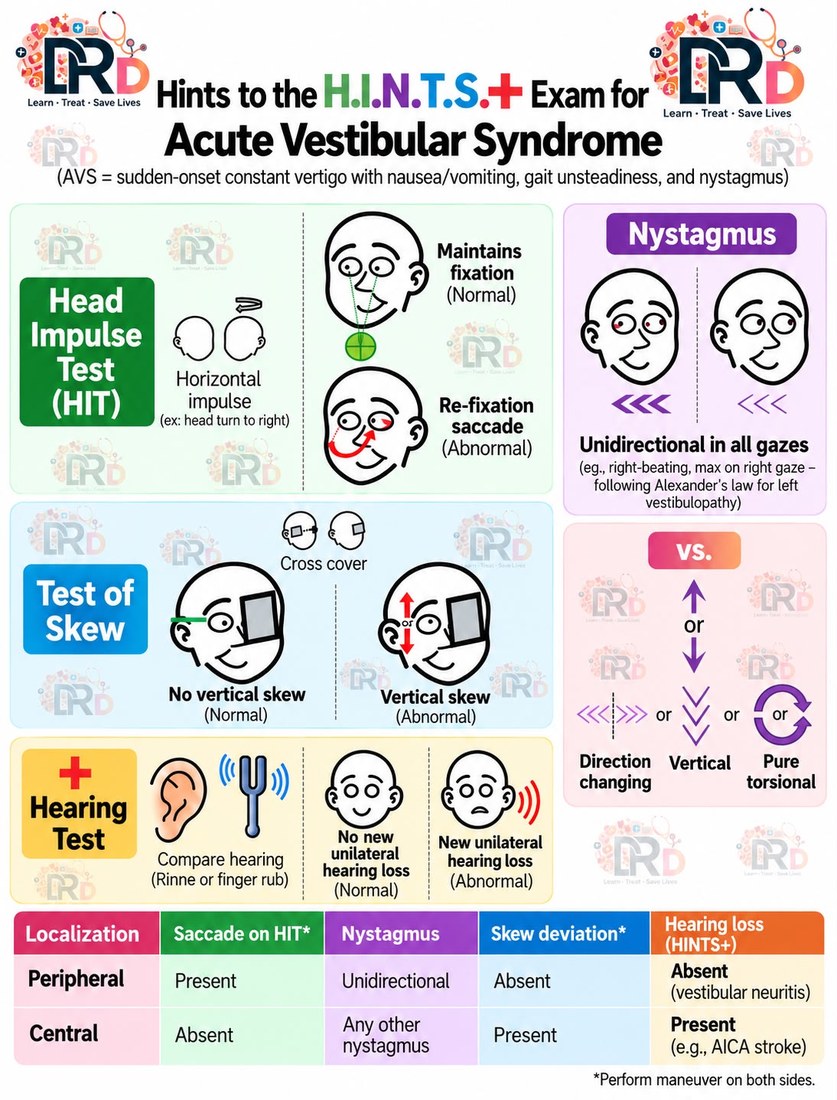
- Central-type nystagmus (vertical/down-beating, direction-changing, no latency or fatigue), or other neurological signs → exclude posterior fossa pathology
- New headache, limb/gait ataxia, diplopia, dysarthria → urgent neurological assessment
- Sudden hearing loss with vertigo → urgent ENT (exclude labyrinthine/central cause)
Assessment
Differential diagnosis
- Vestibular neuronitis / labyrinthitis (prolonged, continuous vertigo)
- Ménière disease (vertigo with fluctuating hearing loss, tinnitus, aural fullness)
- Vestibular migraine
- Central positional vertigo / posterior fossa pathology (down-beating or direction-changing nystagmus, no latency/fatigue, other neurology) — exclude
- Orthostatic hypotension / presyncope
Investigations
- DIX–HALLPIKE test for posterior/anterior canal BPPV: look for torsional up-beating nystagmus with LATENCY, that is paroxysmal, FATIGUABLE and lasts <1 minute, reproducing vertigo
- Supine roll (head-turn) test for horizontal (lateral) canal BPPV
- No imaging in typical, test-positive BPPV; image/refer if atypical features suggest a central cause
- Review medications and lying/standing BP if presyncope is possible
Management
- Take a positional history and perform Dix–Hallpike (both sides) to identify the affected canal.
- Treat posterior canal BPPV with the EPLEY canalith-repositioning manoeuvre (particle repositioning) — the key therapeutic step; the Semont manoeuvre is an alternative.
- For horizontal canal BPPV, use a Lempert (barbecue) roll or Gufoni manoeuvre.
- Reassess (repeat Dix–Hallpike) to confirm resolution; teach Brandt–Daroff exercises for residual/recurrent symptoms.
- Reassure; avoid vestibular suppressants beyond very short-term symptomatic use (they hinder compensation and do not treat the cause).
- Safety-net for falls; advise that recurrence is common and manoeuvres can be repeated.
- Refer to ENT/vestibular/neurology for atypical features, central signs, treatment-resistant cases, or diagnostic doubt.
Drugs & doses
Canalith-repositioning manoeuvres (Epley/Semont for posterior; Lempert/Gufoni for horizontal) — the definitive treatment, not a drug
Vestibular sedatives (e.g. prochlorperazine, cinnarizine) — only very short-term for severe acute symptoms; avoid routine/prolonged use
Disposition
Diagnose and treat at the bedside in primary/ambulatory care; refer for atypical/central features, persistent symptoms, or when repositioning cannot be performed.
Complications & pitfalls
- Falls and injury
- Anxiety and activity avoidance
- Persistent/recurrent symptoms requiring repeat manoeuvres
Exam pearls
- Dix–Hallpike diagnoses, Epley treats — most posterior-canal BPPV resolves after one or two manoeuvres.
- Latency, brief duration and fatiguability point to peripheral BPPV; their absence or vertical nystagmus suggests a central cause.
- Vestibular suppressants delay recovery — avoid beyond the acute phase.
Educational — confirm all doses against local policy.
Disclaimer: Educational decision support for qualified clinicians and students — not a substitute for clinical judgement, local protocols or a full drug reference. Confirm every dose and contraindication against your formulary before prescribing.