Cannot intubate, cannot oxygenate (CICO) — emergency front-of-neck access
Airway · ENT
Physician-written · Verified by three sets of doctors · Reviewed November 2026
Bedside summary
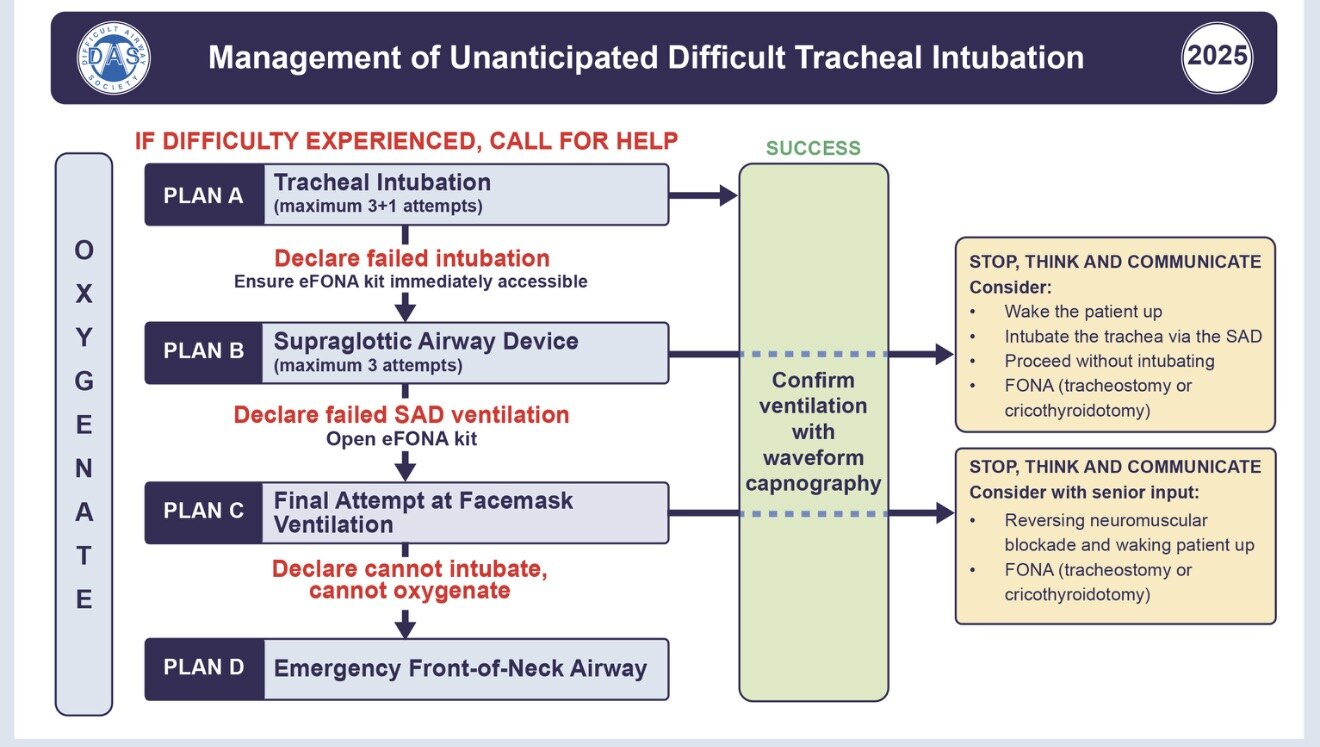
The final, life-saving step in a failed airway when intubation, supraglottic airway and face-mask ventilation have all failed and the patient cannot be oxygenated. The priority is DECLARING CICO early and performing emergency front-of-neck access (eFONA) — a scalpel-bougie-tube cricothyroidotomy in adults — without delay. Hypoxia kills; indecision is the main cause of death.
Figures & algorithms
Red flags
- Delaying front-of-neck access while re-attempting intubation
- Unrecognised oesophageal/false-passage placement
- Impalpable neck (obesity, haematoma, radiotherapy) — consider ultrasound/surgical approach
- Failure to confirm with capnography
Assessment
Differential diagnosis
- Confirm this is true CICO: failed intubation PLUS failed SGA PLUS failed face-mask ventilation with falling SpO2
- In children, needle/cannula techniques and specialist help differ — follow paediatric difficult-airway guidance
Investigations
- Continuous SpO2 and waveform capnography; clinical recognition of the CICO situation is the key "test"
- Identify the cricothyroid membrane by palpation (laryngeal handshake); use ultrasound if time and the neck is impalpable
Management
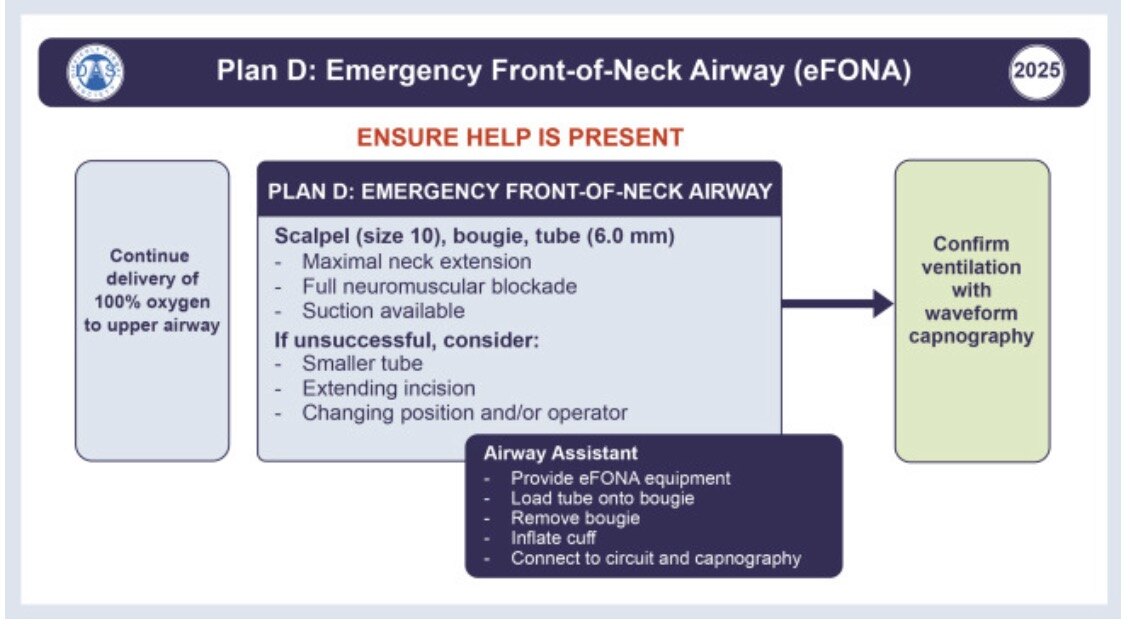
- Declare CICO out loud, call for help, and move to emergency front-of-neck access — do not keep re-attempting intubation.
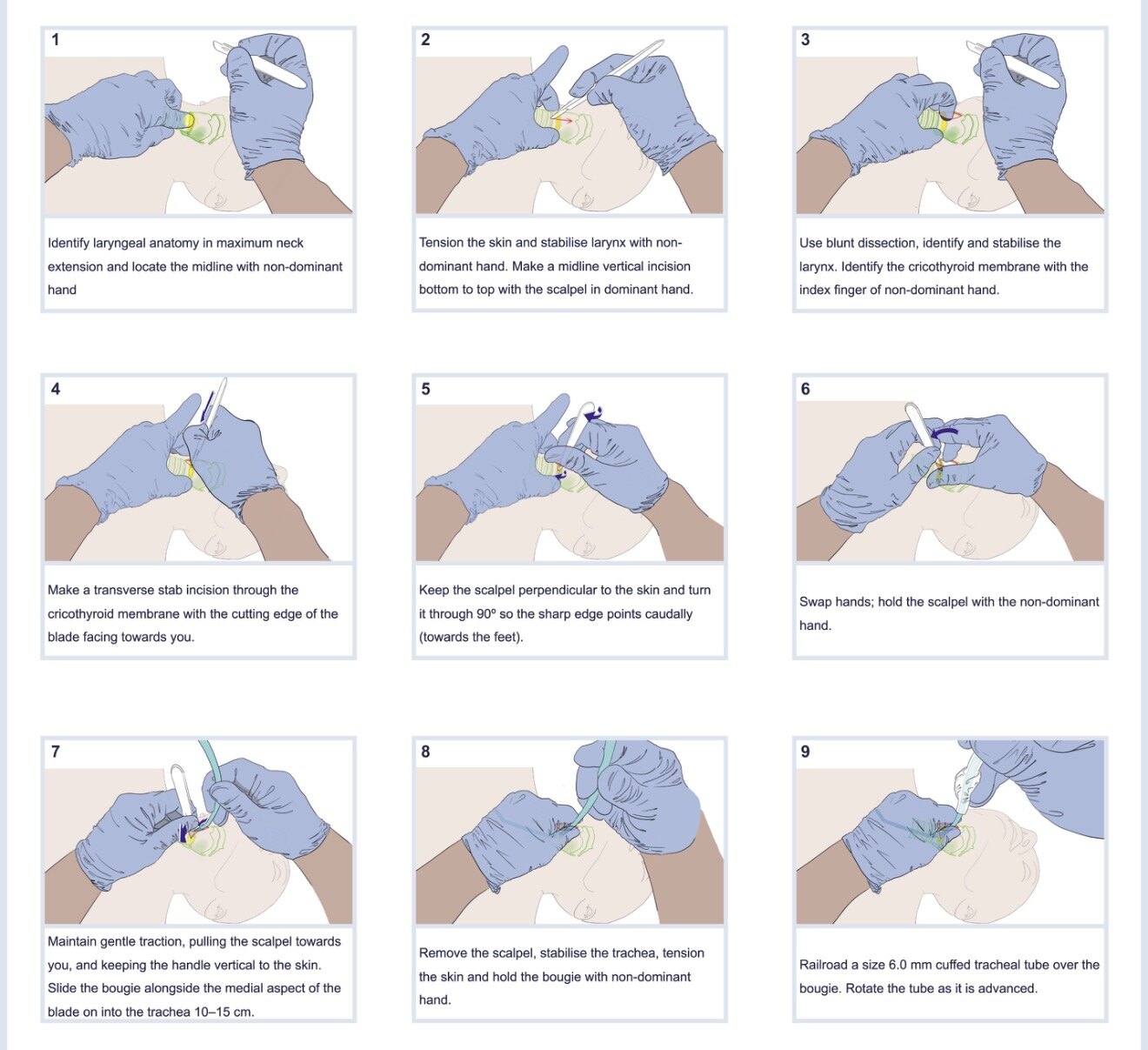
- Position: extend the neck, identify the cricothyroid membrane (laryngeal handshake).
- Scalpel-bougie-tube technique (DAS, adult): a transverse stab incision through the cricothyroid membrane, rotate the blade, railroad a bougie into the trachea, then slide a cuffed size-6.0 tube over the bougie.
- Inflate the cuff, confirm placement with capnography, ventilate and secure the tube.
- Maintain oxygenation throughout; prepare for conversion to a formal surgical airway/tracheostomy by ENT/surgery.
- Debrief and document; this is a never-delay, team-based emergency.
Drugs & doses
Ensure full neuromuscular blockade is NOT the obstacle — paralysis can improve mask ventilation/laryngoscopy; follow RSI drug protocol (confirm against local policy)
Oxygen (the goal of the procedure); sedation as needed once oxygenated
No drug substitutes for front-of-neck access in true CICO
Disposition
Critical care with ENT/anaesthetic/surgical involvement; formalise the surgical airway and investigate the precipitating cause.
Complications & pitfalls
- Hypoxic brain injury / arrest from delay
- Bleeding, false passage, tube misplacement
- Laryngeal/tracheal injury
Exam pearls
- Declare CICO early and commit to front-of-neck access — hesitation is the biggest killer.
- Scalpel-bougie-tube through the cricothyroid membrane is the default adult technique.
- Confirm with capnography; prepare for ENT/surgical conversion afterwards.
Educational — confirm all equipment/technique against local policy.
Disclaimer: Educational decision support for qualified clinicians and students — not a substitute for clinical judgement, local protocols or a full drug reference. Confirm every dose and contraindication against your formulary before prescribing.