Erythema migrans & early Lyme disease
Infection · Dermatology
Physician-written · Verified by three sets of doctors · Reviewed November 2026
Bedside summary
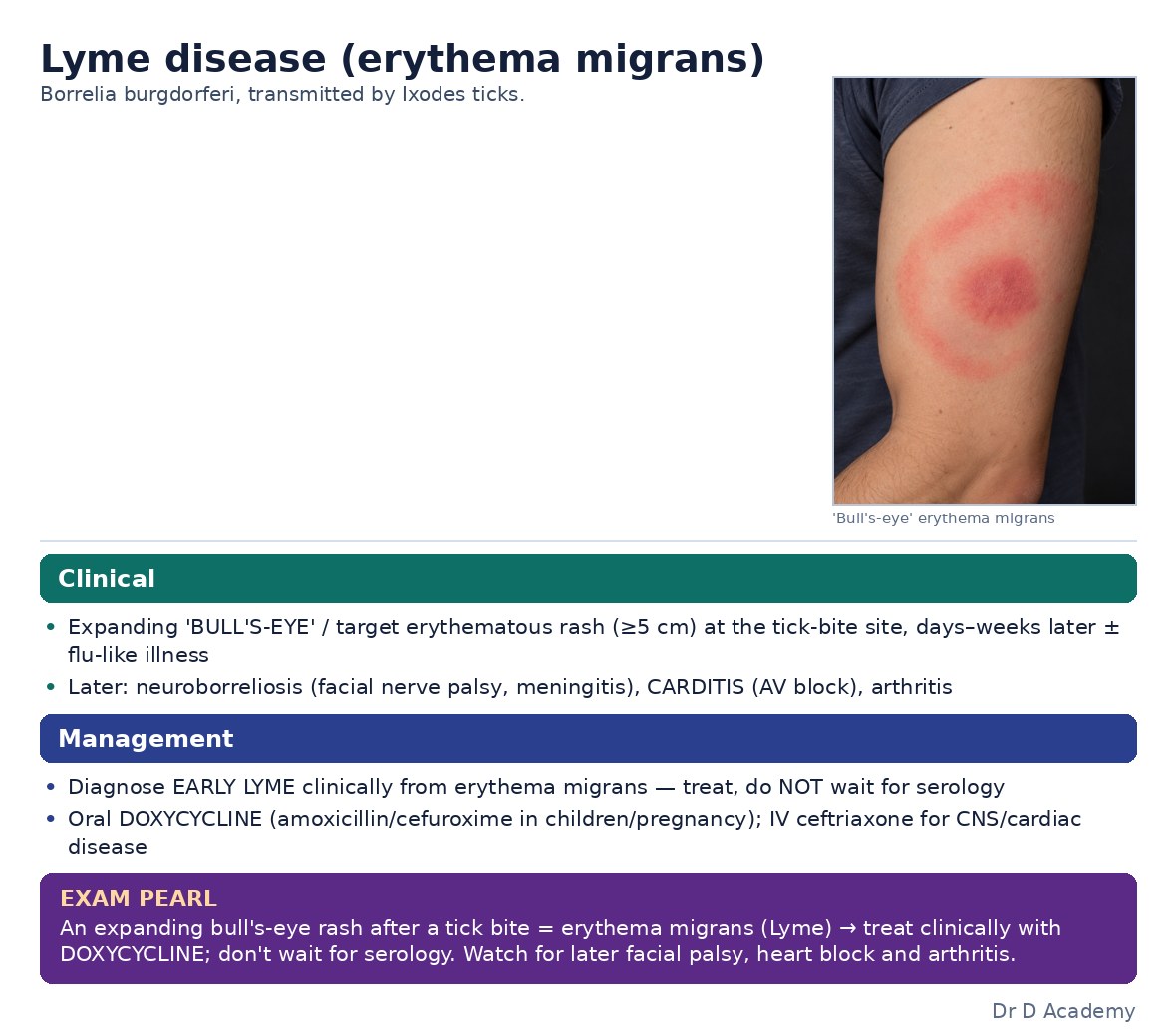
Erythema migrans is the earliest and most specific sign of Lyme borreliosis: an expanding erythematous patch (often but not always with central clearing) appearing days to weeks after an Ixodes tick bite. It is a CLINICAL diagnosis — treat on sight without waiting for serology, which is often negative this early. Early oral antibiotics prevent progression to disseminated (neurological, cardiac, arthritic) disease.
Figures & algorithms
Red flags
- Facial/cranial nerve palsy or meningism (early neuroborreliosis)
- Palpitations, syncope or bradycardia (Lyme carditis — AV block)
- Multiple erythema migrans lesions (dissemination)
- Severe systemic illness suggesting tick-borne co-infection
Assessment
Differential diagnosis
- Tick-bite hypersensitivity reaction (appears within hours, small, does not expand over days)
- Cellulitis / erysipelas (usually hotter, more tender, febrile)
- Tinea corporis, granuloma annulare, fixed drug eruption, urticaria
- Multiple erythema migrans lesions indicate early DISSEMINATED Lyme
Investigations
- Erythema migrans is a clinical diagnosis — do NOT delay treatment for serology (early seronegativity is common)
- For suspected disseminated disease (neuro/cardiac/joint) use two-tier serology (EIA then immunoblot, or modified two-tier)
- ECG if carditis suspected (palpitations, syncope, dyspnoea — look for AV block)
- Document tick exposure, bite site, travel to endemic areas and symptom timeline
Management
- Recognise the expanding (>5 cm) annular or homogeneous erythema at/near a tick-bite site and treat empirically.
- Start a first-line oral antibiotic for 10–14 days (doxycycline preferred; amoxicillin or cefuroxime axetil as alternatives).
- Remove any attached tick promptly with fine forceps close to the skin; consider single-dose doxycycline prophylaxis only in defined high-risk bites per local policy.
- Assess for early disseminated features: multiple EM lesions, facial/cranial nerve palsy, meningitis, radiculopathy, or carditis (heart block).
- Refer disseminated neuroborreliosis or Lyme carditis for IV therapy / specialist and cardiology input (temporary pacing if high-grade block).
- Advise on tick-bite prevention and safety-net for new neurological, cardiac or joint symptoms.
Drugs & doses
Doxycycline 100 mg PO BD for 10–14 days — first-line (also covers co-infecting Anaplasma); avoid in pregnancy (confirm against local policy)
Amoxicillin 500 mg PO TDS for 14 days — alternative, suitable in pregnancy/children (confirm against local policy)
Cefuroxime axetil 500 mg PO BD for 14 days — alternative (confirm against local policy)
Disseminated neuroborreliosis / carditis: IV ceftriaxone or oral doxycycline per specialist guidance (confirm against local policy)
Single-dose doxycycline 200 mg PO as post-exposure prophylaxis only for qualifying high-risk tick bites (confirm against local policy)
Disposition
Discharge most early localised cases on oral antibiotics with safety-netting; admit Lyme carditis with high-grade block and refer neuroborreliosis for specialist IV therapy.
Complications & pitfalls
- Lyme neuroborreliosis (cranial neuropathy, meningitis, radiculopathy)
- Lyme carditis with high-grade AV block
- Lyme arthritis (late)
- Post-treatment Lyme symptoms
Exam pearls
- Erythema migrans is a clinical diagnosis — treat on sight; early serology is often falsely negative.
- Doxycycline is first-line and also treats possible Anaplasma co-infection.
- New heart block in a young patient with a rash and tick exposure is Lyme carditis until proven otherwise.
Educational — confirm all doses against local policy.
Disclaimer: Educational decision support for qualified clinicians and students — not a substitute for clinical judgement, local protocols or a full drug reference. Confirm every dose and contraindication against your formulary before prescribing.