Kawasaki disease (mucocutaneous presentation)
Vasculitis · Dermatology
Physician-written · Verified by three sets of doctors · Reviewed November 2026
Bedside summary
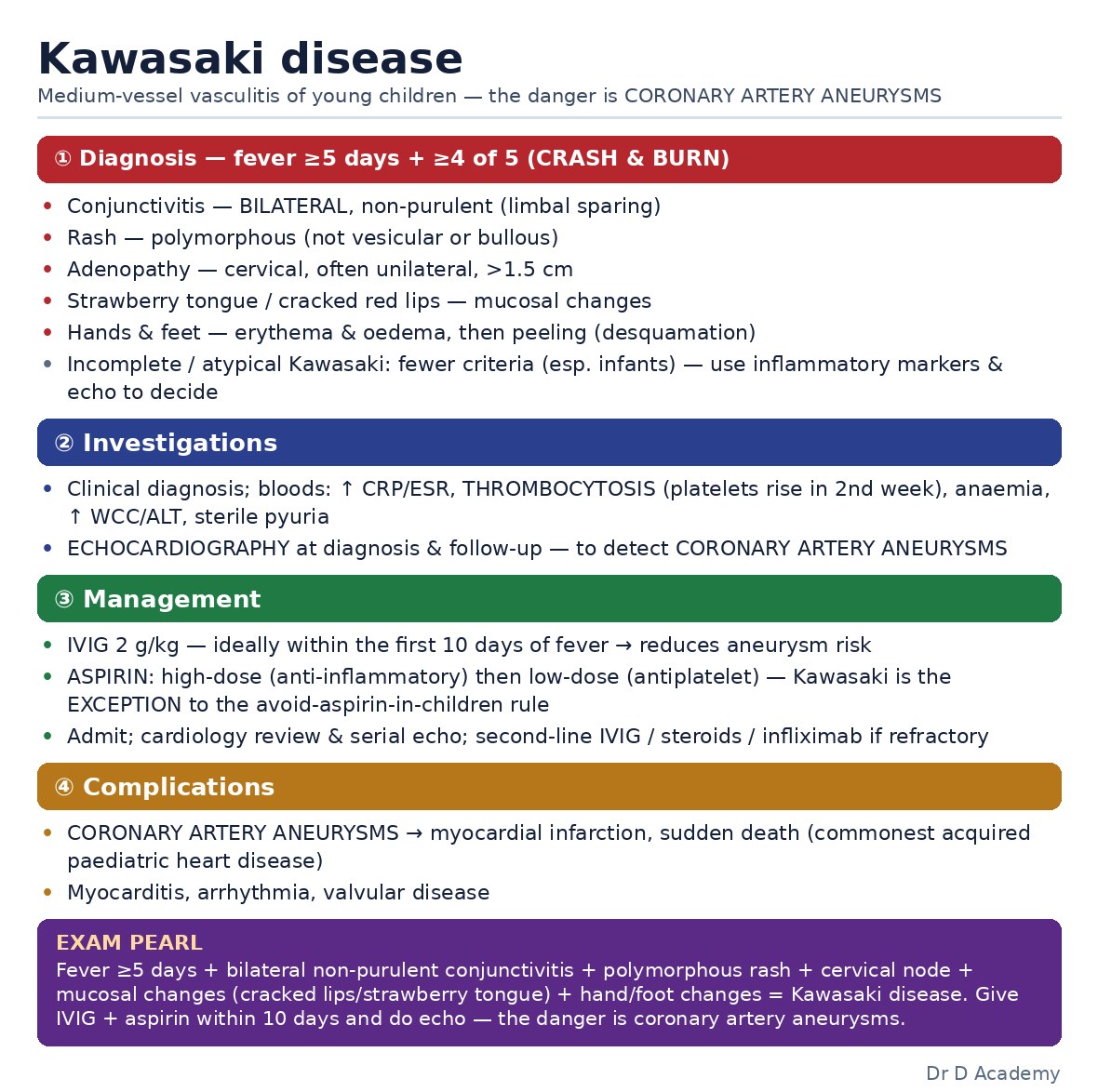
Kawasaki disease is an acute medium-vessel vasculitis of early childhood and the leading cause of acquired paediatric heart disease. The mucocutaneous signs are central to diagnosis: prolonged fever plus conjunctivitis, oral mucosal changes, polymorphous rash, extremity changes and cervical lymphadenopathy. PROMPT treatment with IVIG within the first 10 days reduces the risk of coronary artery aneurysms — recognition cannot wait.
Figures & algorithms
Red flags
- Fever beyond 5 days with mucocutaneous features (treat promptly)
- Infant <6 months with prolonged unexplained fever (atypical Kawasaki, high aneurysm risk)
- Shock or cardiac dysfunction (Kawasaki disease shock syndrome)
- IVIG non-response (persistent/recrudescent fever)
Assessment
Differential diagnosis
- Viral exanthems (measles, adenovirus, enterovirus, EBV)
- Scarlet fever / staphylococcal or streptococcal toxin-mediated disease / toxic shock
- Stevens–Johnson syndrome and severe drug reactions
- Multisystem inflammatory syndrome in children (MIS-C) and systemic JIA
Investigations
- Clinical diagnosis: fever ≥5 days (or treat earlier if criteria met) plus ≥4 of — bilateral non-exudative conjunctivitis, mucosal changes (cracked red lips, strawberry tongue), polymorphous rash, extremity changes (erythema/oedema then periungual peeling), and cervical lymphadenopathy
- Bloods: raised CRP/ESR, neutrophilia, anaemia, thrombocytosis (often from the second week), hypoalbuminaemia, transaminitis, sterile pyuria
- Echocardiography to assess coronary arteries at baseline and on follow-up
- Consider incomplete/atypical Kawasaki in prolonged unexplained fever with fewer features (especially in infants)
Management
- Recognise the pattern — prolonged fever plus the mucocutaneous features — and involve paediatrics urgently.
- Give IVIG as the mainstay, ideally within the first 10 days of illness, to reduce coronary aneurysm risk.
- Add aspirin (anti-inflammatory dosing initially, then low-dose antiplatelet once afebrile) per local protocol.
- Arrange baseline echocardiography and cardiology input; repeat imaging on follow-up.
- Consider adjunctive corticosteroids or additional agents in high-risk children or IVIG non-responders per specialist guidance.
- Admit, monitor for IVIG resistance (persistent/recrudescent fever) and arrange structured cardiac follow-up.
Drugs & doses
Intravenous immunoglobulin (IVIG) 2 g/kg as a single infusion — mainstay; most effective within the first 10 days (confirm against local policy)
Aspirin — higher anti-inflammatory dose while febrile, then low antiplatelet dose; per local paediatric protocol (confirm against local policy)
Corticosteroids as adjunct/first-line in high-risk patients or for IVIG resistance (confirm against local policy)
Second-line for IVIG-resistant disease (e.g. second IVIG dose, infliximab) under specialist care (confirm against local policy)
Disposition
Admit under paediatrics for IVIG, echocardiography and monitoring; arrange cardiology follow-up and ongoing coronary surveillance.
Complications & pitfalls
- Coronary artery aneurysms, thrombosis and myocardial infarction
- Myocarditis and arrhythmia
- Kawasaki disease shock syndrome
- IVIG resistance
Exam pearls
- Treat within the first 10 days — IVIG timing is what protects the coronary arteries.
- Consider incomplete Kawasaki in any infant with prolonged unexplained fever.
- Periungual (fingertip) peeling appears in the subacute phase and supports the diagnosis retrospectively.
Educational — confirm all doses against local policy.
Disclaimer: Educational decision support for qualified clinicians and students — not a substitute for clinical judgement, local protocols or a full drug reference. Confirm every dose and contraindication against your formulary before prescribing.