Otitis media with effusion (glue ear)
Bedside summary
Collection of non-infected fluid in the middle ear without acute inflammation, extremely common in young children and the leading cause of acquired childhood hearing loss. Usually follows eustachian tube dysfunction and often resolves spontaneously within ~3 months. The main concern is the effect of conductive hearing loss on speech, language, learning and behaviour. Also occurs in adults — where UNILATERAL OME mandates exclusion of a postnasal space (nasopharyngeal) tumour.
Figures & algorithms
Red flags
- Adult UNILATERAL OME → urgent exclusion of nasopharyngeal carcinoma
- Foul discharge, retraction pocket or crust in the attic → suspect cholesteatoma
- Speech/language delay or significant persistent hearing loss → expedite referral
Assessment
Differential diagnosis
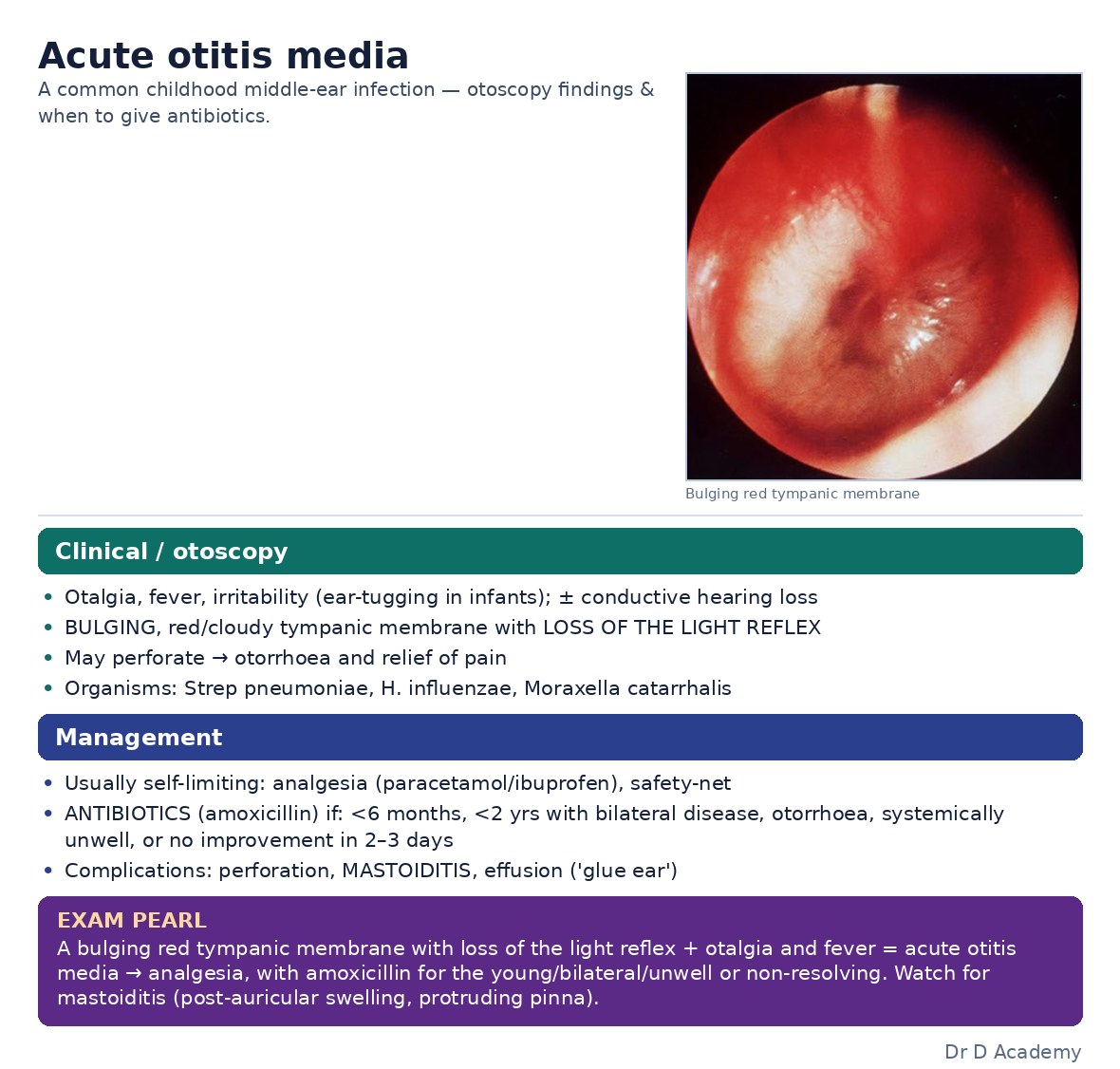
- Acute otitis media (painful, inflamed, bulging/erythematous drum)
- Chronic suppurative otitis media / cholesteatoma
- Sensorineural hearing loss
- Adult unilateral OME: nasopharyngeal carcinoma (examine the postnasal space)
- Cerumen impaction (also causes conductive loss)
Investigations
- Otoscopy: dull, retracted or bulging drum, loss of light reflex, air–fluid level/bubbles, amber/grey effusion
- Tympanometry (type B flat trace supports effusion) and age-appropriate audiometry/hearing assessment
- Active observation ("watchful waiting") with repeat assessment over ~3 months before intervention
- Adults with unilateral OME: nasendoscopy of the postnasal space to exclude nasopharyngeal tumour
Management
- Confirm the diagnosis and quantify hearing loss; explain the usually self-limiting course.
- Active observation for ~3 months in otherwise well children — most resolve spontaneously; avoid antibiotics, antihistamines, decongestants and intranasal steroids (not effective for OME).
- Support communication: favourable seating, reduced background noise, clear face-to-face speech; inform school.
- Autoinflation (e.g. balloon devices) can help motivated older children as a non-surgical option.
- If persistent bilateral OME (≥3 months) with significant hearing loss or developmental/educational impact → refer ENT for grommets (ventilation tubes) ± adenoidectomy.
- Consider hearing aids as an alternative to surgery (e.g. where surgery is contraindicated or declined).
- Have a lower threshold and closer follow-up in children with Down syndrome or cleft palate (higher risk, altered surgical considerations).
Drugs & doses
Disposition
Complications & pitfalls
- Speech, language, learning and behavioural effects from persistent hearing loss
- Tympanic membrane retraction/atelectasis and retraction pockets
- Progression to chronic middle-ear disease/cholesteatoma
- Grommet-related: otorrhoea, early extrusion, persistent perforation, tympanosclerosis
Exam pearls
- Most childhood OME resolves within 3 months — active observation, not antibiotics.
- Unilateral OME in an adult = examine the postnasal space to exclude nasopharyngeal cancer.
- Document the hearing/developmental impact — it drives the decision to operate.
Educational — confirm all doses against local policy. Antibiotic doses per BNF (current edition); confirm choice in the in-app Antibiotic Dosing tool.
Disclaimer: Educational decision support for qualified clinicians and students — not a substitute for clinical judgement, local protocols or a full drug reference. Confirm every dose and contraindication against your formulary before prescribing.