Large bowel obstruction (mechanical)
LBO · GI / Surgical
Physician-written · Verified by three sets of doctors · Reviewed November 2026
Bedside summary
Mechanical blockage of the colon, most commonly from colorectal cancer, followed by volvulus and diverticular stricture. A competent ileocaecal valve creates a closed loop with caecal distension and perforation risk.
Figures & algorithms
Red flags
- Caecal diameter >12 cm (impending perforation)
- Peritonism or free air (perforation)
- Rising lactate / ischaemia
- Closed-loop obstruction on CT
- Haemodynamic instability
Assessment
Differential diagnosis
- Obstructing colorectal cancer
- Sigmoid or caecal volvulus
- Diverticular stricture
- Acute colonic pseudo-obstruction (Ogilvie)
- Faecal impaction
- Extrinsic compression / peritoneal disease
- Inflammatory stricture
Investigations
- CT abdomen/pelvis with contrast (level, cause, closed loop, perforation)
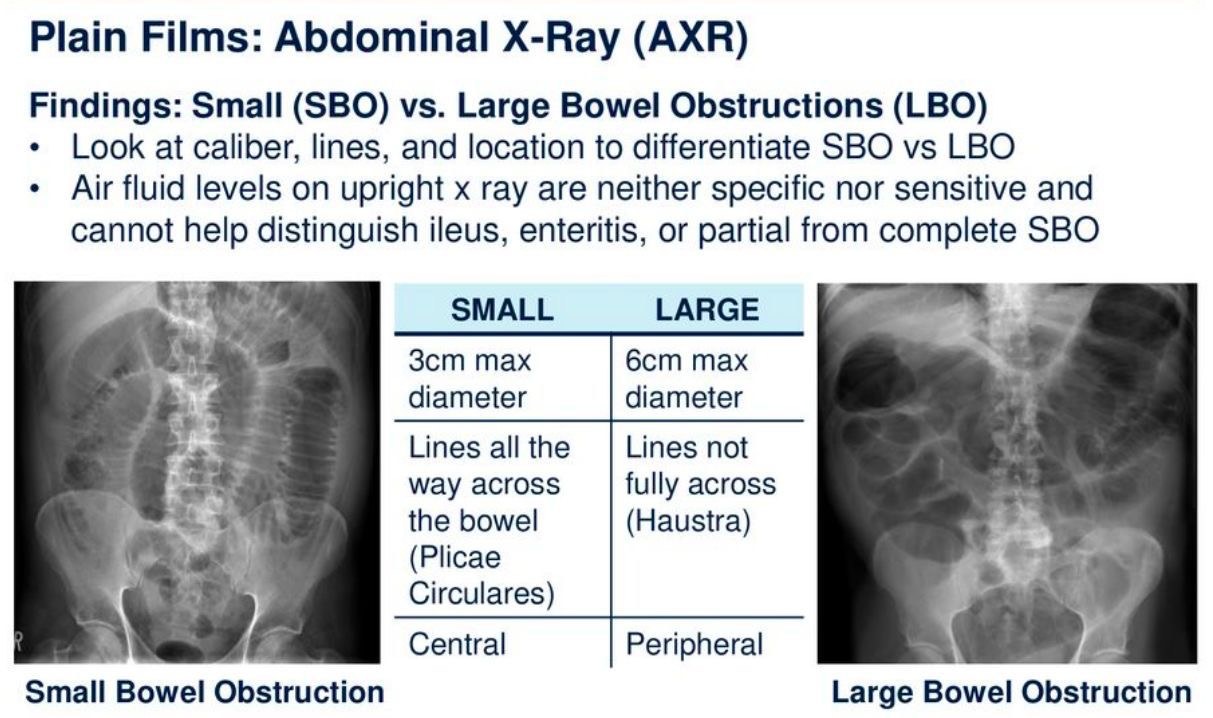
- Abdominal X-ray (colonic distension, caecal diameter)
- FBC, U&E, CRP, lactate, venous gas
- Group & save and clotting
- CEA if malignancy suspected
- Water-soluble contrast enema or CT to confirm mechanical vs pseudo-obstruction
- Flexible sigmoidoscopy for suspected sigmoid volvulus
Management
- Resuscitate with IV fluids and correct electrolytes; insert NG tube if vomiting
- Catheterise and monitor urine output; give analgesia and antiemetics
- Obtain CT to define site, cause and complications (closed loop, ischaemia, perforation)
- Distinguish mechanical obstruction from pseudo-obstruction before intervention
- Assess caecal diameter (>10-12 cm) as a perforation risk marker
- For sigmoid volvulus attempt endoscopic decompression and flatus tube if no ischaemia
- For obstructing cancer decide between emergency resection, defunctioning stoma or self-expanding metal stent (as bridge or palliation)
- Give VTE prophylaxis and perioperative antibiotics
- Take to theatre urgently if ischaemia, perforation or closed-loop obstruction
- Consider stenting as a bridge to surgery in left-sided malignant obstruction in selected cases
- Stage and discuss confirmed malignancy at colorectal MDT
- Plan nutrition and stoma care for operative patients
Drugs & doses
Balanced crystalloid resuscitation (e.g. Hartmann's) titrated to response
Piperacillin-tazobactam 4.5 g IV TDS if perforation/ischaemia
Metoclopramide avoided; use cyclizine 50 mg IV/IM TDS or ondansetron 4 mg IV
Enoxaparin 40 mg SC OD
Morphine 2.5-5 mg IV titrated for pain
Disposition
Emergency general/colorectal surgical admission; urgent theatre for ischaemia/perforation/closed loop. Refer confirmed malignancy to the colorectal MDT.
Complications & pitfalls
- Caecal perforation and faecal peritonitis
- Bowel ischaemia
- Anastomotic leak after emergency resection
- Stoma complications
- Stent migration or perforation
- Sepsis and multi-organ failure
Exam pearls
- Colorectal cancer is the commonest cause of mechanical LBO in adults
- A competent ileocaecal valve converts LBO into a dangerous closed loop
- Always exclude pseudo-obstruction before operating — Ogilvie's is managed medically/endoscopically
- Stenting can bridge left-sided malignant obstruction to elective one-stage surgery in selected patients
Disclaimer: Educational decision support for qualified clinicians and students — not a substitute for clinical judgement, local protocols or a full drug reference. Confirm every dose and contraindication against your formulary before prescribing.