Management of the difficult airway in paediatric anaesthesia
Bedside summary
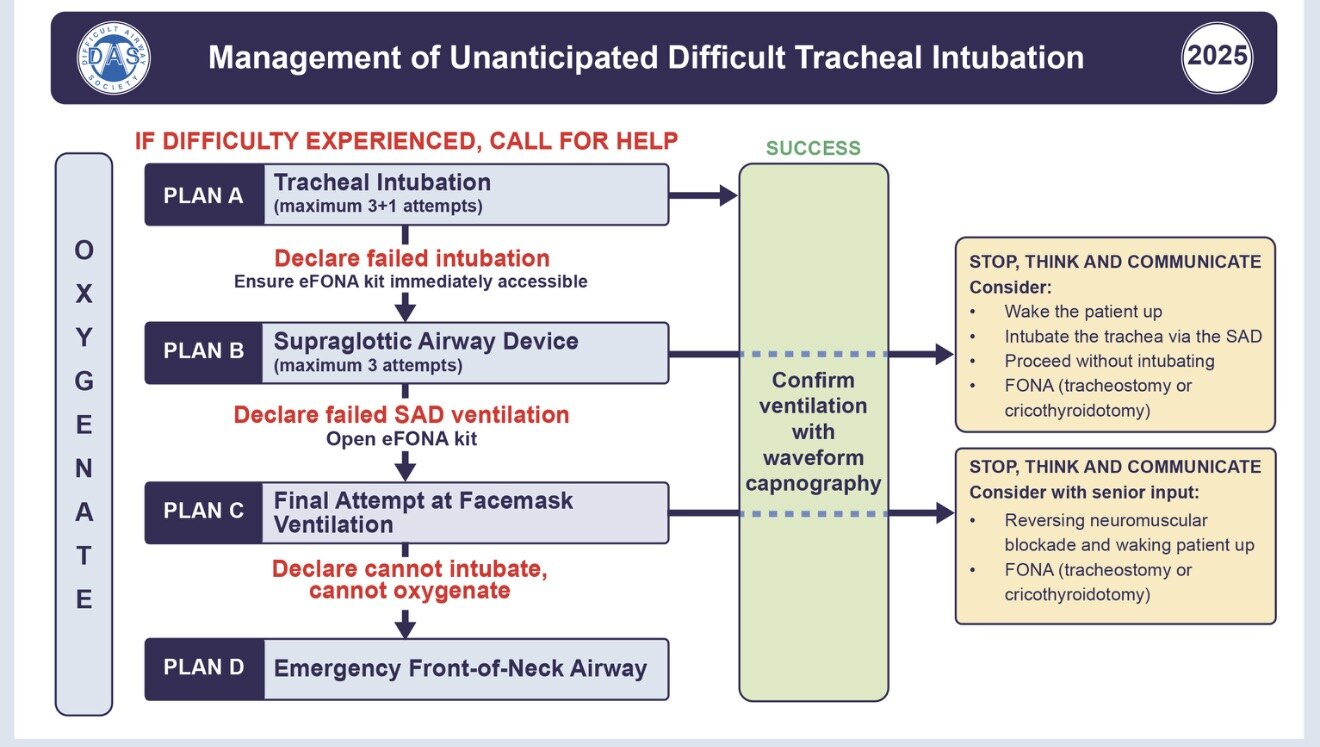
Failure to secure a child's airway can cause hypoxic injury within minutes, and children desaturate faster than adults. Difficulty may be anticipated from assessment or arise unexpectedly — and in neonates/infants up to two-thirds of difficult intubations are unanticipated. Planning, a limited number of attempts, continuous oxygenation and early escalation are the core safety principles.
Figures & algorithms
Red flags
- Neonate/infant — highest risk of unanticipated difficulty and rapid hypoxaemia
- Multiple direct-laryngoscopy attempts converting a stable airway into CICO (oedema, bleeding, laryngospasm)
- Weight <10 kg or short thyromental distance — higher complication rate
- Falling saturations despite apparent airway in place — functional obstruction (laryngospasm)
Assessment
Differential diagnosis
- Anticipated vs unanticipated difficulty
- Difficult mask ventilation vs difficult intubation vs difficult SGA
- Functional obstruction (laryngospasm) vs anatomical difficulty
- Cannot-intubate-cannot-oxygenate (CICO)
Investigations
- Airway assessment for predictors (micrognathia/short thyromental distance, limited mouth opening, reduced neck mobility)
- Identify craniofacial syndromes (Treacher Collins, Pierre Robin, Goldenhar) and weight <10 kg as risk markers
- Confirm tube position with capnography
- Have an airway-exchange and rescue plan documented before induction
Management
- Manage the anticipated difficult airway at a centre experienced with paediatric airways where feasible; reschedule/transfer stable patients
- Perform a Time Out: primary and backup airway manager, roles, primary/backup technique, equipment, and need for ENT surgeon or ECMO
- Obtain IV access before induction whenever possible; otherwise prepare IM succinylcholine and atropine
- Give supplemental oxygen throughout, including apnoea (apnoeic oxygenation) — recommended for all neonates and anyone at risk of rapid desaturation
- Use an advanced technique (videolaryngoscopy, flexible scope, or scope through an SGA) for the first attempt; limit direct laryngoscopy to a single attempt before switching
- If mask ventilation is adequate with rescue available, a neuromuscular blocker can improve intubating conditions (especially in infants)
- Reassess oxygenation after every attempt; wake/postpone if ≥4 attempts by two providers or the child is deteriorating and the case can be delayed
Drugs & doses
Disposition
Complications & pitfalls
- Cardiac arrest (the commonest severe complication, ~2% in a difficult-intubation registry)
- Hypoxaemia (~9%), the commonest non-severe event
- Airway trauma, oedema and failed extubation (~5%, mostly infants <10 kg)
- Oesophageal/through-and-trachea injury during front-of-neck access
Exam pearls
- Flexible scope intubation through an SGA allows continuous ventilation and has higher first-pass success than videolaryngoscopy in infants <1 year (described as 54% vs 36%); it is preferred in infants <5 kg
- A hyperangulated videolaryngoscope blade can make tube delivery difficult in infants — a standard Macintosh/Miller video blade may do better below ~5 kg
- Recognise and treat functional obstruction (laryngospasm) by deepening anaesthesia — it is a frequent, reversible cause of difficult ventilation in children
- For front-of-neck access in children <8 years, enter between tracheal rings (the cricothyroid membrane is too small); a scalpel–bougie surgical approach is likely the best emergency option in all paediatric patients
- Plan extubation as carefully as intubation: fully reverse block, position head-up, let oedema settle, have ENT and reintubation kit ready, and extubate awake
Oxygenate continuously, limit attempts, and move early to an advanced technique or help — the goal is to avoid irreversible deterioration, not to succeed with any one tool.
Disclaimer: Educational decision support for qualified clinicians and students — not a substitute for clinical judgement, local protocols or a full drug reference. Confirm every dose and contraindication against your formulary before prescribing.