Meckel diverticulum — painless lower GI bleed
Bedside summary
A Meckel diverticulum is the commonest congenital GI anomaly (a remnant of the vitelline duct) and the classic cause of significant PAINLESS rectal bleeding in a young child. Ectopic gastric mucosa within it secretes acid that ulcerates adjacent ileum, causing brisk, sometimes large-volume bleeding. It can also present with obstruction or a Meckel's diverticulitis mimicking appendicitis — resuscitate, transfuse if needed, and involve surgery.
Figures & algorithms
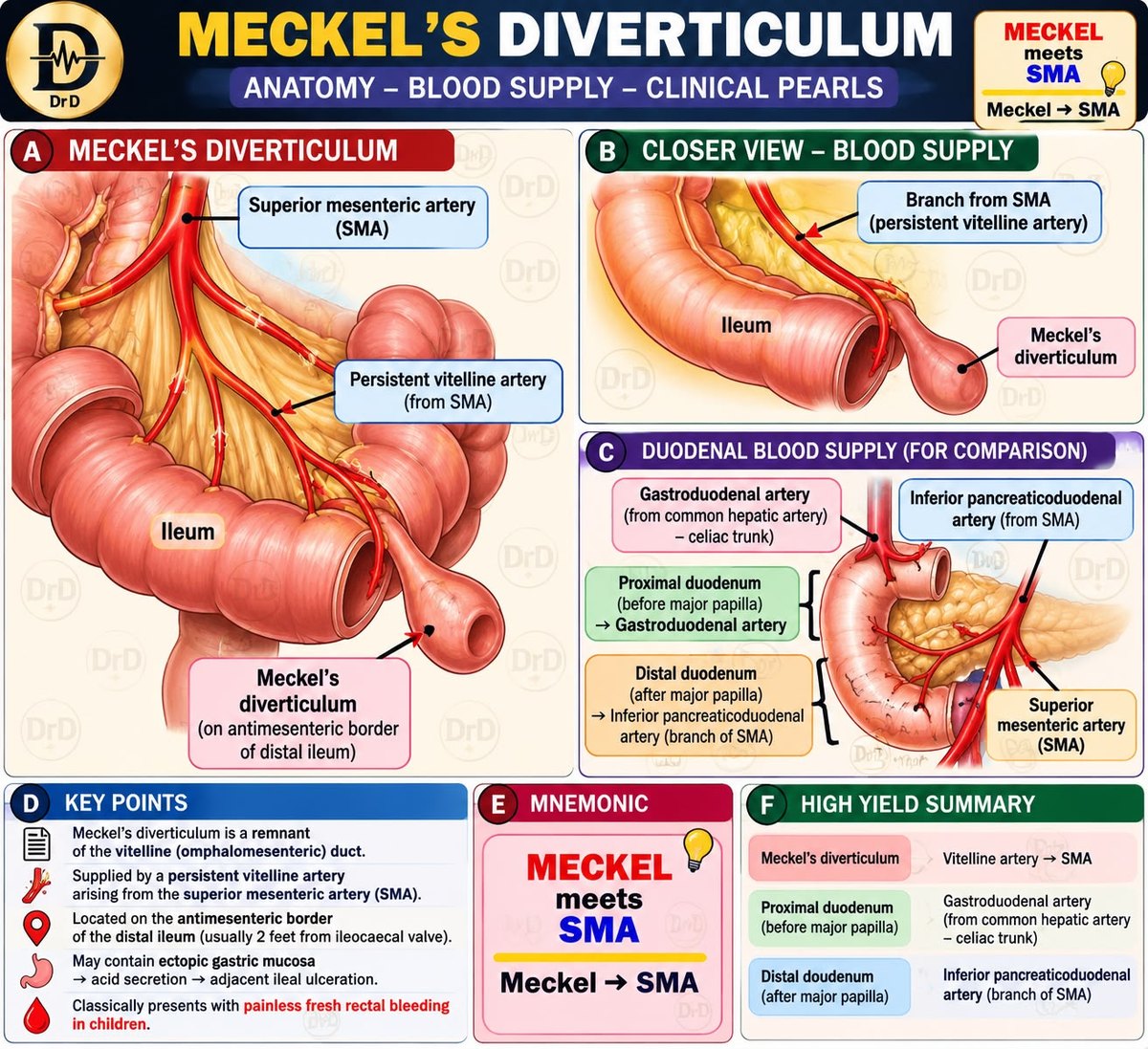
Red flags
- Haemodynamic instability from significant bleeding
- Signs of obstruction (bilious vomiting, distension) or peritonism (diverticulitis/perforation)
- Ongoing or recurrent large-volume bleeding
- Severe anaemia requiring transfusion
Assessment
Differential diagnosis
- Other causes of paediatric lower GI bleed: intussusception, infective colitis, polyp, anal fissure, IBD, HSP
- Meckel's can also present as obstruction (volvulus/intussusception lead point) or diverticulitis (appendicitis mimic)
Investigations
- Assess haemodynamics and haemoglobin; group and save/crossmatch for significant bleeding
- TECHNETIUM-99m pertechnetate scan ("Meckel scan") detects ectopic gastric mucosa — the key investigation for the bleeding presentation
- Consider other imaging for obstruction/diverticulitis; a negative scan does not fully exclude it if suspicion is high
Management
- Resuscitate: assess circulation, gain access, give fluid and TRANSFUSE for significant blood loss.
- Investigate with a Meckel (technetium pertechnetate) scan when painless significant lower GI bleeding is suspected.
- Involve paediatric surgery early — definitive treatment of a symptomatic Meckel is surgical resection.
- For obstruction or diverticulitis presentations, resuscitate and manage as an acute surgical abdomen with surgical review.
- Correct coagulopathy/anaemia and monitor for re-bleeding.
- Keep nil by mouth pending surgical decision; provide analgesia and antiemesis as needed.
Drugs & doses
Disposition
Complications & pitfalls
- Significant haemorrhage and shock
- Bowel obstruction (lead point for intussusception/volvulus)
- Diverticulitis and perforation
- Recurrent bleeding
Exam pearls
- Think Meckel in a young child with significant PAINLESS rectal bleeding.
- The technetium pertechnetate (Meckel) scan finds the ectopic gastric mucosa.
- Resuscitate and transfuse as needed; the cure is surgical resection.
Educational — confirm all doses against local policy. Antibiotic doses per BNF (current edition); confirm choice in the in-app Antibiotic Dosing tool.
Disclaimer: Educational decision support for qualified clinicians and students — not a substitute for clinical judgement, local protocols or a full drug reference. Confirm every dose and contraindication against your formulary before prescribing.