Needle cricothyroidotomy & percutaneous transtracheal ventilation (paediatric rescue)
Bedside summary
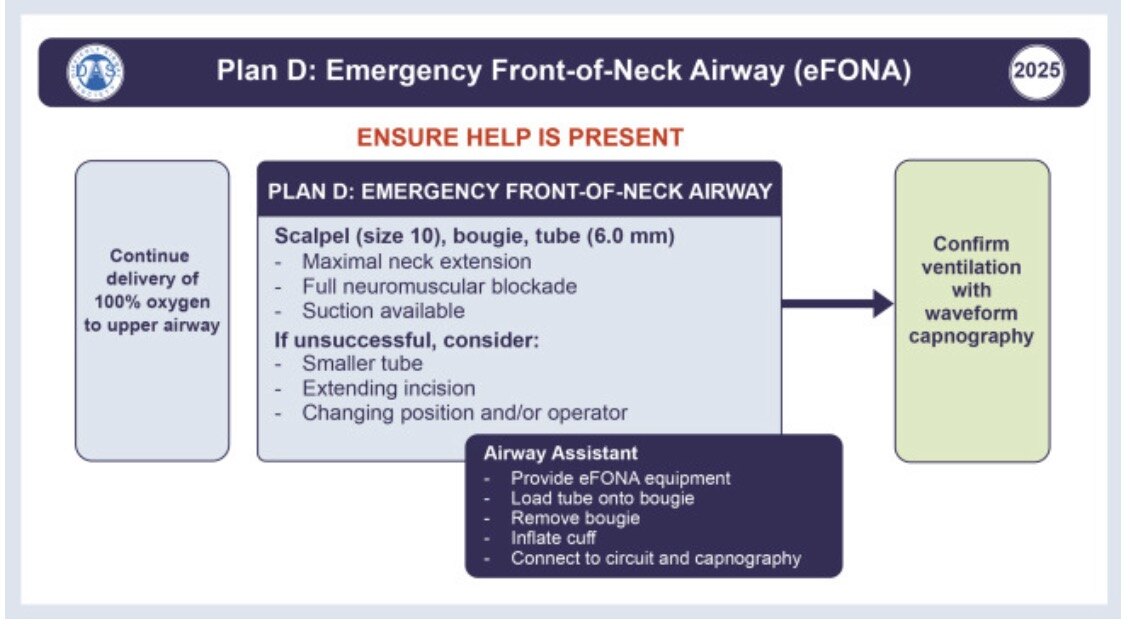
Needle cricothyroidotomy passes an over-the-needle catheter through the cricothyroid membrane to oxygenate and ventilate a child in a 'cannot intubate, cannot ventilate' (CICO) emergency after bag-mask ventilation, supraglottic rescue and intubation have failed or are not feasible. Ventilation is then delivered as percutaneous transtracheal ventilation (PTV) via an improvised device. It is a temporising, last-resort rescue with significant potential morbidity.
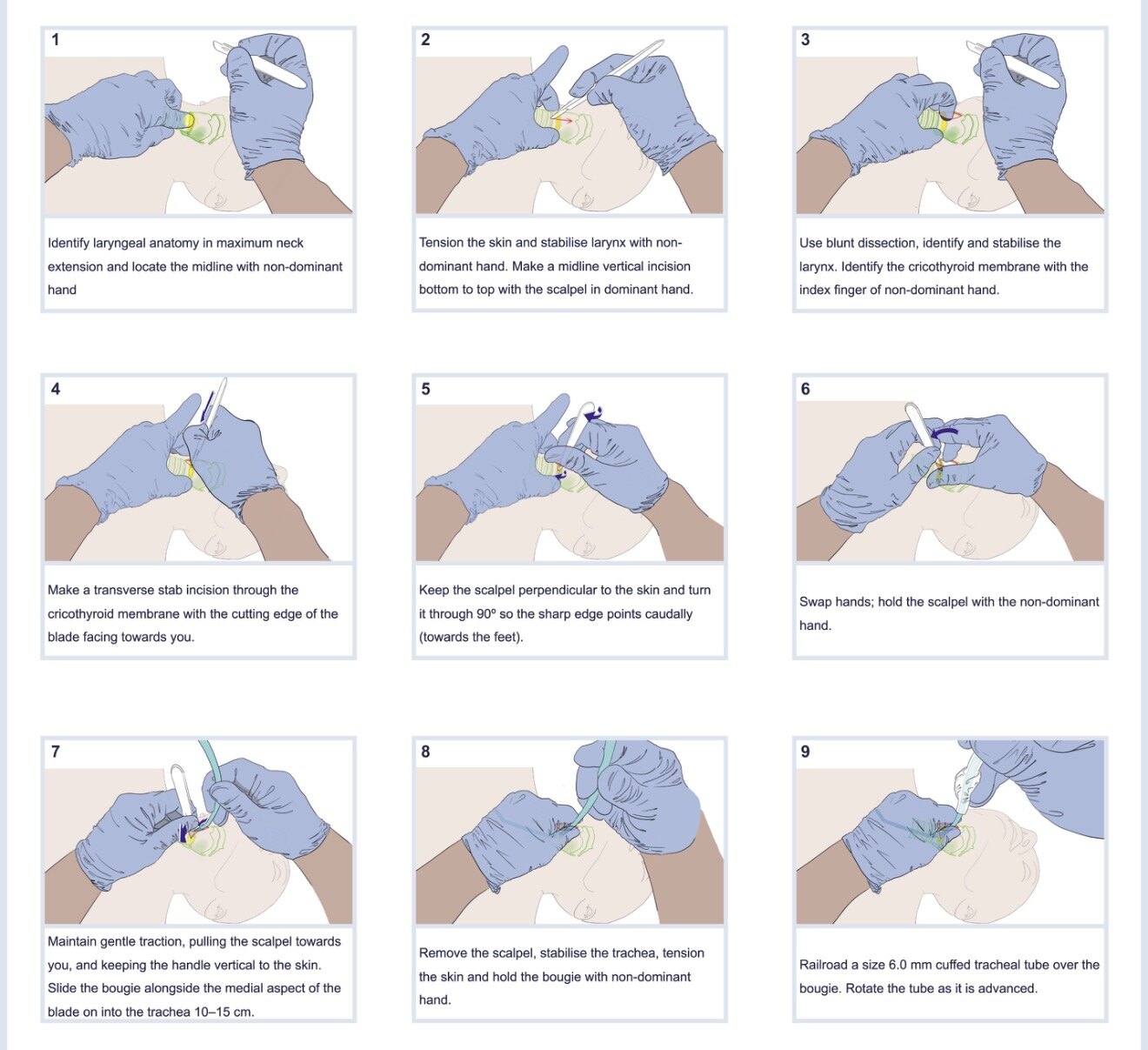
Figures & algorithms
Red flags
- Pulmonary barotrauma — pneumothorax, pneumomediastinum, hyperinflation and reduced venous return/hypotension — worst with COMPLETE upper-airway obstruction
- Subcutaneous emphysema from catheter kinking/dislodgement or repeated punctures (may signal a displaced cannula)
- Hypercarbia with prolonged use — avoid/limit with raised intracranial pressure, where it is especially harmful
Assessment
Differential diagnosis
- Needle cricothyroidotomy — preferable in infants/children up to ~10–12 years (anatomically easier, less airway damage)
- Surgical cricothyroidotomy — for a fully formed cricoid cartilage (≥10–12 years) and adults (larger tube, more effective ventilation)
- Seldinger/wire-guided cricothyroidotomy — a separate technique
Investigations
- Identify the cricothyroid membrane by palpation; in infants/young children palpate the trachea above the suprasternal notch and move up to the cricoid, puncturing just above it in the midline
- Bedside ultrasound may help locate the membrane — palpation is often inaccurate in children
- Monitor HR/rhythm, BP, SpO2 and capnography; watch chest rise AND fall; chest radiograph to exclude barotrauma
Management
- Position supine; extend the neck to expose landmarks UNLESS cervical-spine injury is suspected.
- Attach a 16–18 gauge IV catheter (infants/young children) — or 12–16 gauge / 6 Fr (adolescents/adults) — to a 3–10 mL syringe part-filled with saline.
- Puncture the midline, central/lower part of the membrane (avoid the cricothyroid vessels that lie superiorly and laterally), directed caudally at 30–45°.
- Advance with continuous negative pressure on the syringe until air bubbles confirm an intratracheal position; slide the catheter off the needle to the hub and hold it FIRMLY at all times (it kinks/dislodges easily).
- Ventilate (PTV): connect to a self-inflating bag via a 3 mm ID tube adapter, or to wall/high-pressure oxygen through a manual in-line valve (side-port, Y-connector or three-way stopcock) or a Ventrain device. Do NOT use the anaesthetic-machine common gas outlet.
- Use a longer expiratory time if the upper airway is obstructed; adjust to maintain SpO2 and watch for chest fall with expiration.
Drugs & doses
Disposition
Complications & pitfalls
- Catheter kinking/dislodgement or inability to place (PTV failed in ~21% in one emergency series)
- Posterior tracheal wall injury, bleeding, infection
- Less efficient ventilation than a tracheal tube (up to a third of oxygen escapes up the glottis)
Exam pearls
- Oxygen driving pressure/flow is deliberately LOWER in children to prevent barotrauma: infants/under-12s ~25–35 psi (wall flow ~10–12 L/min) versus ~50 psi (up to 15 L/min) in adolescents/adults — confirm against local protocol.
- Suggested ventilation: I:E ~1:4–1:5 at 10–12 breaths/min for most children; raised ICP ~1:2–1:3 at 15–20/min; partial/complete obstruction ~1:8–1:10 at only 5–6/min with long expiration — confirm against local protocol.
- The narrow trachea, small cricothyroid membrane (neonatal mean height only ~2.6 mm) and pliable cartilage make the procedure technically hard in small children — place the largest catheter the anatomy allows.
- PTV was traditionally a short-term (<45 min) measure, but if oxygenation is maintained, even marked hypercarbia can be tolerated for longer — still move to a definitive airway as soon as possible.
- The Ventrain device promotes active expiration and can work with oxygen flow as low as ~15 L/min, permitting use even with complete obstruction proximal to the membrane.
In CICO in a small child, needle cricothyroidotomy with low-pressure transtracheal ventilation buys oxygenation time — use lower pressures/longer expiration than in adults to avoid barotrauma, hold the catheter at all times, and convert to a definitive airway fast.
Disclaimer: Educational decision support for qualified clinicians and students — not a substitute for clinical judgement, local protocols or a full drug reference. Confirm every dose and contraindication against your formulary before prescribing.