Coral snake (elapid) envenomation
Bedside summary
Coral snakes (Micrurus) are neurotoxic elapids. Unlike pit-vipers, local signs (pain, swelling) are often MINIMAL, but venom blocks the neuromuscular junction and can cause DELAYED (up to ~12 h or more), progressive descending flaccid paralysis — ptosis, diplopia, dysarthria, dysphagia, limb weakness → respiratory failure. Absence of local signs does NOT mean no envenomation.
Figures & algorithms
Red flags
- Ptosis, diplopia, dysarthria or dysphagia (early neurotoxicity)
- Falling vital capacity / respiratory effort
- Any bulbar weakness
- Progressive limb weakness
Assessment
Differential diagnosis
- Pit-viper (Crotalinae) bite (haematotoxic, prominent local injury)
- Non-venomous snakebite
- Botulism / myasthenic crisis
- Guillain–Barré
- Tick paralysis
Investigations
- Largely clinical + serial NEUROLOGIC exam (ptosis, extra-ocular movements, bulbar function, grip, respiratory effort)
- Baseline spirometry / vital capacity and continuous SpO₂ to track respiratory decline
- FBC, U&E, CK; bloods to exclude Crotalinae coagulopathy if species uncertain
Management
- Move away from the snake; keep the patient calm and immobilise the limb; remove rings/constricting items.
- A PRESSURE-IMMOBILISATION bandage is reasonable for a neurotoxic elapid bite (contrast with pit-vipers) — apply if trained and transfer is delayed.
- Transfer urgently to a facility with antivenom; consult a medical tox(poison-centre) service early.
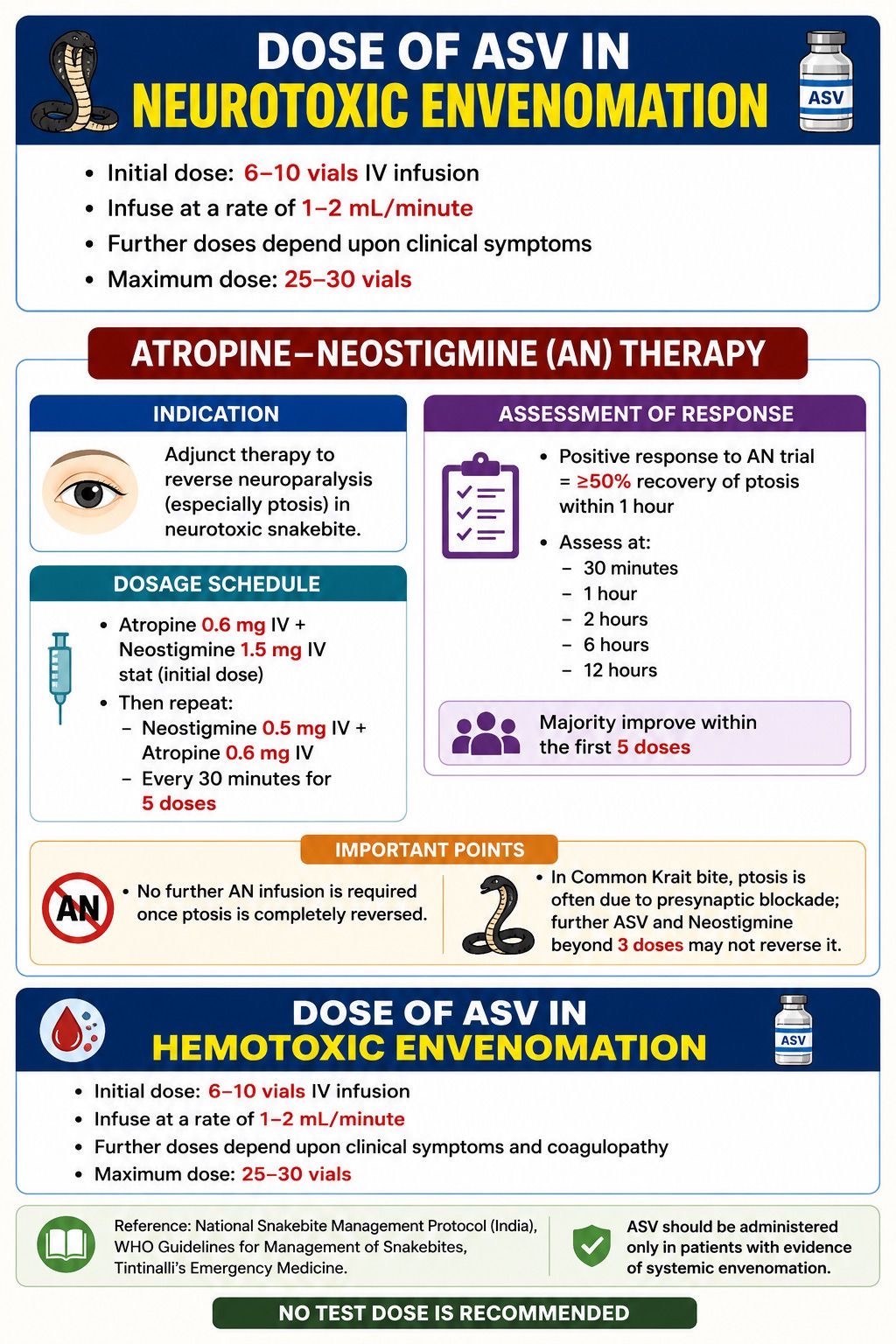
- Give coral-snake ANTIVENOM EARLY on signs or strong suspicion of envenomation — once paralysis is established it is hard to reverse; do not wait for florid weakness.
- Protect the airway and support ventilation proactively — intubate for bulbar weakness or failing vital capacity; be prepared for PROLONGED mechanical ventilation.
- Admit and observe for at least ~24 h even if initially asymptomatic, because neurotoxicity is delayed.
Drugs & doses
Disposition
Complications & pitfalls
- Respiratory failure from neuromuscular paralysis
- Aspiration
- Prolonged ventilator dependence
- Antivenom anaphylaxis / serum sickness
Exam pearls
- No local signs ≠ no envenomation — coral-snake toxicity is neurologic and delayed.
- Pressure-immobilisation is FOR elapids (coral) and AGAINST pit-vipers (Crotalinae) — know which snake you have.
- Give antivenom early and support the airway before paralysis is complete.
- Observe ≥ 24 h; symptoms can appear many hours after a “nothing” bite.
Neurotoxic and delayed: immobilise (pressure-immobilisation is appropriate here), give antivenom early on suspicion, guard the airway, and observe ≥ 24 h even if asymptomatic.
Disclaimer: Educational decision support for qualified clinicians and students — not a substitute for clinical judgement, local protocols or a full drug reference. Confirm every dose and contraindication against your formulary before prescribing.