Gout, hyperuricaemia & pseudogout (CPPD / calcium pyrophosphate disease)
crystal-arthropathy · Metabolic
Physician-written · Verified by three sets of doctors · Reviewed November 2026
Bedside summary
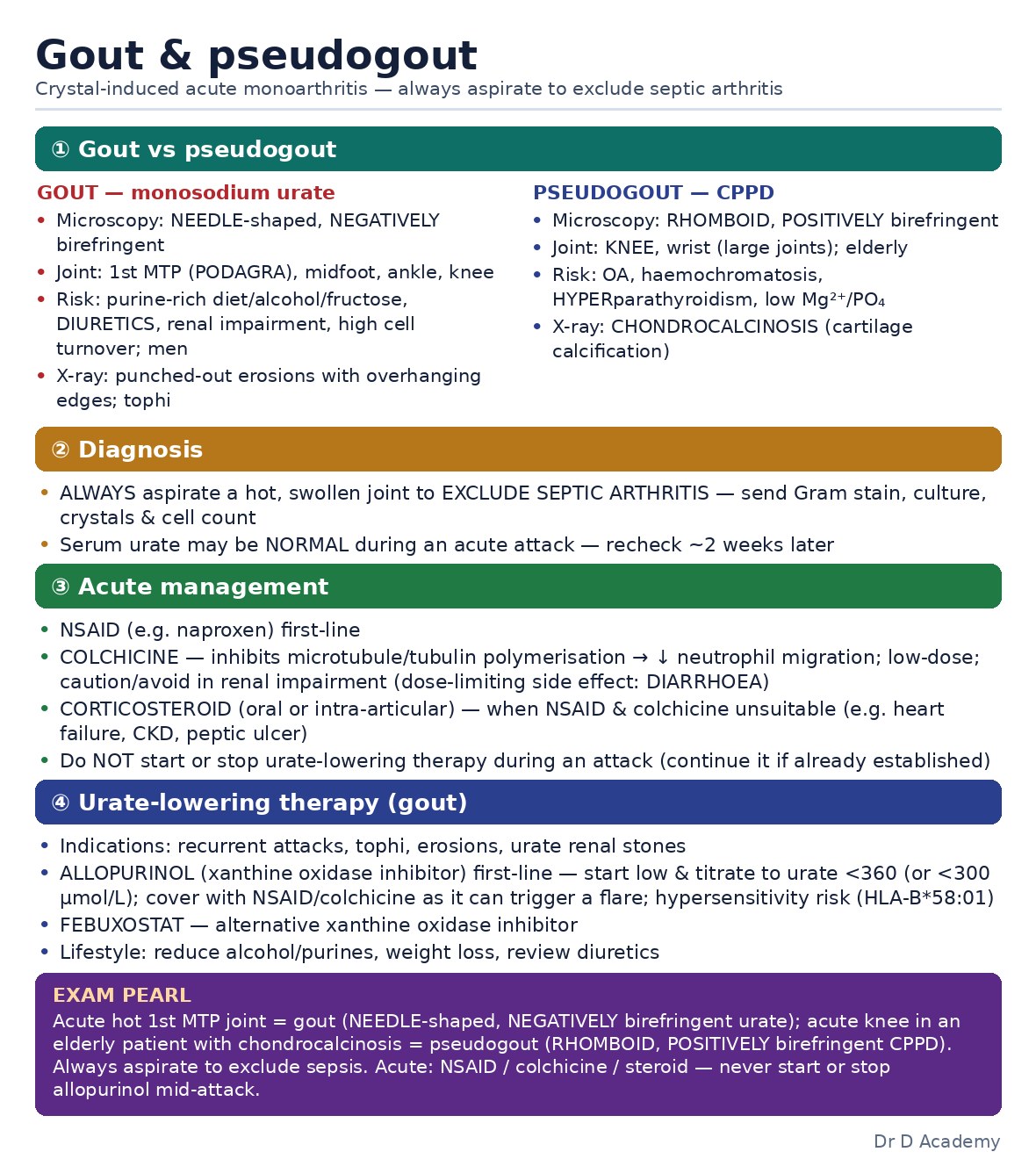
Monosodium urate crystal deposition (gout) or calcium pyrophosphate (CPPD/pseudogout) causing acute monoarthritis/oligoarthritis. Gout: raised urate, 1st MTP (podagra) classic, risk with CKD, diuretics, alcohol, high purine, tumour lysis. Pseudogout: older, knees/wrists, associated with osteoarthritis, haemochromatosis, hyperparathyroidism, hypomagnesaemia, hypophosphatasia. Always exclude septic arthritis.
Figures & algorithms
Red flags
- Hot swollen joint + fever/systemic upset — treat as septic arthritis until aspirate proves otherwise
- Polyarticular flare with sepsis-like picture
- Tumour-lysis syndrome (acute urate rise + AKI + electrolyte derangement)
- Allopurinol hypersensitivity syndrome (DRESS/SJS) — HLA-B*58:01 risk (South-East Asian, Han Chinese)
Assessment
Differential diagnosis
- Septic arthritis (MUST exclude — aspirate, Gram stain, culture)
- Pseudogout (CPPD) vs gout — distinguish on crystal microscopy
- Cellulitis / bursitis overlying joint
- Reactive or psoriatic arthritis, acute flare of osteoarthritis
- Haemarthrosis (trauma/anticoagulation)
Investigations
- Joint aspiration + polarised microscopy: urate = needle-shaped, negatively birefringent; CPPD = rhomboid, positively birefringent
- Synovial fluid Gram stain, culture and cell count to exclude sepsis
- Serum urate (may be normal/low during acute flare — recheck ≥2 weeks after)
- FBC, CRP, U&E/eGFR (dosing + renal gout), glucose, lipids
- If CPPD: calcium/PTH, magnesium, ferritin/transferrin saturation, TSH (screen secondary causes)
- X-ray: chondrocalcinosis in CPPD; punched-out erosions with overhanging edges in chronic tophaceous gout
Management
- Aspirate the joint — confirms crystals AND excludes septic arthritis
- Treat acute flare early with ONE agent: NSAID, colchicine, or oral/intra-articular/IM steroid (choose by comorbidity)
- Low-dose colchicine preferred over high-dose (equal efficacy, fewer GI effects); reduce dose in CKD/elderly and with interacting drugs
- Do not start or stop urate-lowering therapy during the flare — but continue it if already established
- Rest, ice, analgesia; identify and modify triggers (diuretics, alcohol, purines)
- Start urate-lowering therapy (ULT) once settled if: ≥2 flares/year, tophi, urate arthropathy, or urate stones/CKD — with flare prophylaxis cover
- Treat-to-target: titrate ULT to serum urate <360 µmol/L (<6 mg/dL), <300 µmol/L (<5 mg/dL) if tophi
- Pseudogout: NSAID or colchicine or intra-articular steroid for flare; treat underlying metabolic cause; no urate-lowering role
Drugs & doses
Naproxen 500 mg PO bd (or other NSAID) with PPI, for 5-7 days — avoid in CKD/PUD/HF
Colchicine 1 mg PO then 0.5 mg 1 h later, then 0.5 mg 2-3 times daily until settled; reduce in CKD/elderly; avoid with clarithromycin/strong CYP3A4-P-gp inhibitors
Prednisolone 30-35 mg PO od for 5 days (if NSAID/colchicine contraindicated) — safe in CKD
Intra-articular methylprednisolone/triamcinolone for monoarthritis once sepsis excluded
Allopurinol start 100 mg PO od (50 mg if eGFR <30), titrate monthly to urate target; max 900 mg [verify local]
Febuxostat 40-80 mg PO od if allopurinol intolerant (caution/avoid with established CVD)
Colchicine 0.5 mg PO od-bd (or low-dose NSAID) as flare prophylaxis for ≥3-6 months when starting ULT
Rasburicase — reserved for tumour-lysis hyperuricaemia, not chronic gout [verify local]
Disposition
Mostly outpatient. Admit if septic arthritis cannot be excluded, systemically unwell, polyarticular with AKI, or tumour lysis. Rheumatology for recurrent/tophaceous disease and ULT optimisation.
Complications & pitfalls
- Chronic tophaceous gout, joint destruction
- Urate nephrolithiasis, urate nephropathy
- Allopurinol hypersensitivity / DRESS
- Progression of CPPD to destructive arthropathy
Exam pearls
- ACR 2020 gout guideline: allopurinol first-line (including in CKD), START LOW and titrate, treat-to-target urate <6 mg/dL (<360 µmol/L) with flare prophylaxis — not a fixed dose.
- A normal urate during an acute attack does NOT exclude gout; recheck after the flare.
- Never withhold joint aspiration because 'it's obviously gout' — septic arthritis coexists and is limb/life-threatening.
- Low-dose colchicine is as effective as high-dose with far less toxicity (AGREE/ACR).
- Pseudogout mandates a hunt for haemochromatosis, hyperparathyroidism, hypomagnesaemia — especially if young or recurrent.
Disclaimer: Educational decision support for qualified clinicians and students — not a substitute for clinical judgement, local protocols or a full drug reference. Confirm every dose and contraindication against your formulary before prescribing.