Intraocular foreign body (penetrating)
Open-globe variant · Ophthalmology
Physician-written · Verified by three sets of doctors · Reviewed November 2026
Bedside summary
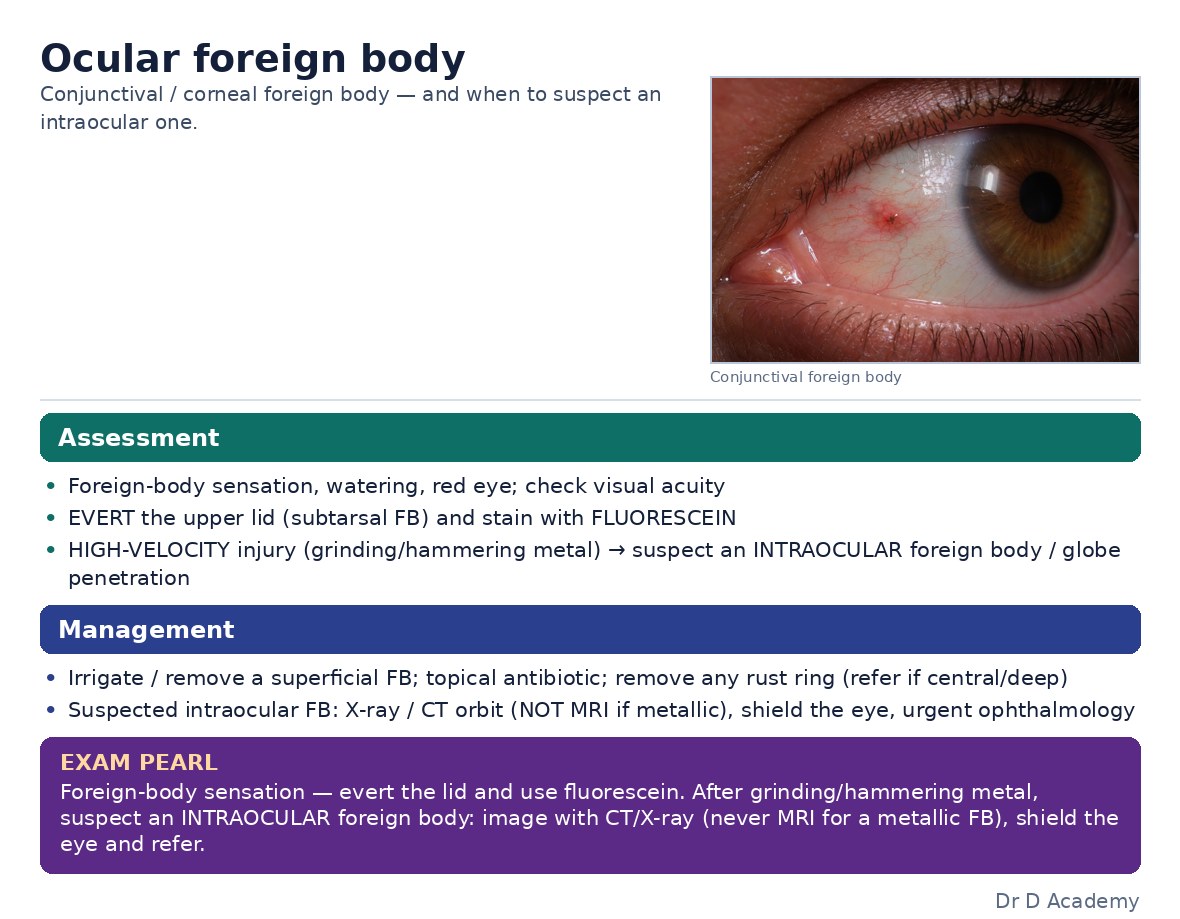
A high-velocity fragment (hammering metal, grinding) can penetrate the globe with deceptively minor external signs. It must be actively excluded, and a metallic foreign body makes MRI dangerous, so imaging and shielding follow open-globe principles.
Figures & algorithms
Assessment
Investigations
- High-risk history (hammering/grinding metal)
- CT orbit (avoid MRI if metallic FB possible)
- Assess for open-globe signs; do not pressure the eye
Management
- Treat as an open globe - rigid eye shield, nil by mouth, antiemetics
- Avoid any pressure on the globe and avoid topical ointments
- IV antibiotics and tetanus prophylaxis
- CT (not MRI) to localise a metallic foreign body
- Urgent ophthalmology referral for removal
Drugs & doses
Empirical antibiotics per BNF — see the in-app Antibiotic Dosing tool
Tetanus prophylaxis
Antiemetics
Disposition
Ophthalmology; theatre.
After hammering or grinding metal, actively exclude an intraocular foreign body - shield the eye and use CT, never MRI. Antibiotic doses per BNF (current edition); confirm choice in the in-app Antibiotic Dosing tool.
Disclaimer: Educational decision support for qualified clinicians and students — not a substitute for clinical judgement, local protocols or a full drug reference. Confirm every dose and contraindication against your formulary before prescribing.