Necrotising scleritis
Inflammation · Ophthalmology
Physician-written · Verified by three sets of doctors · Reviewed November 2026
Bedside summary
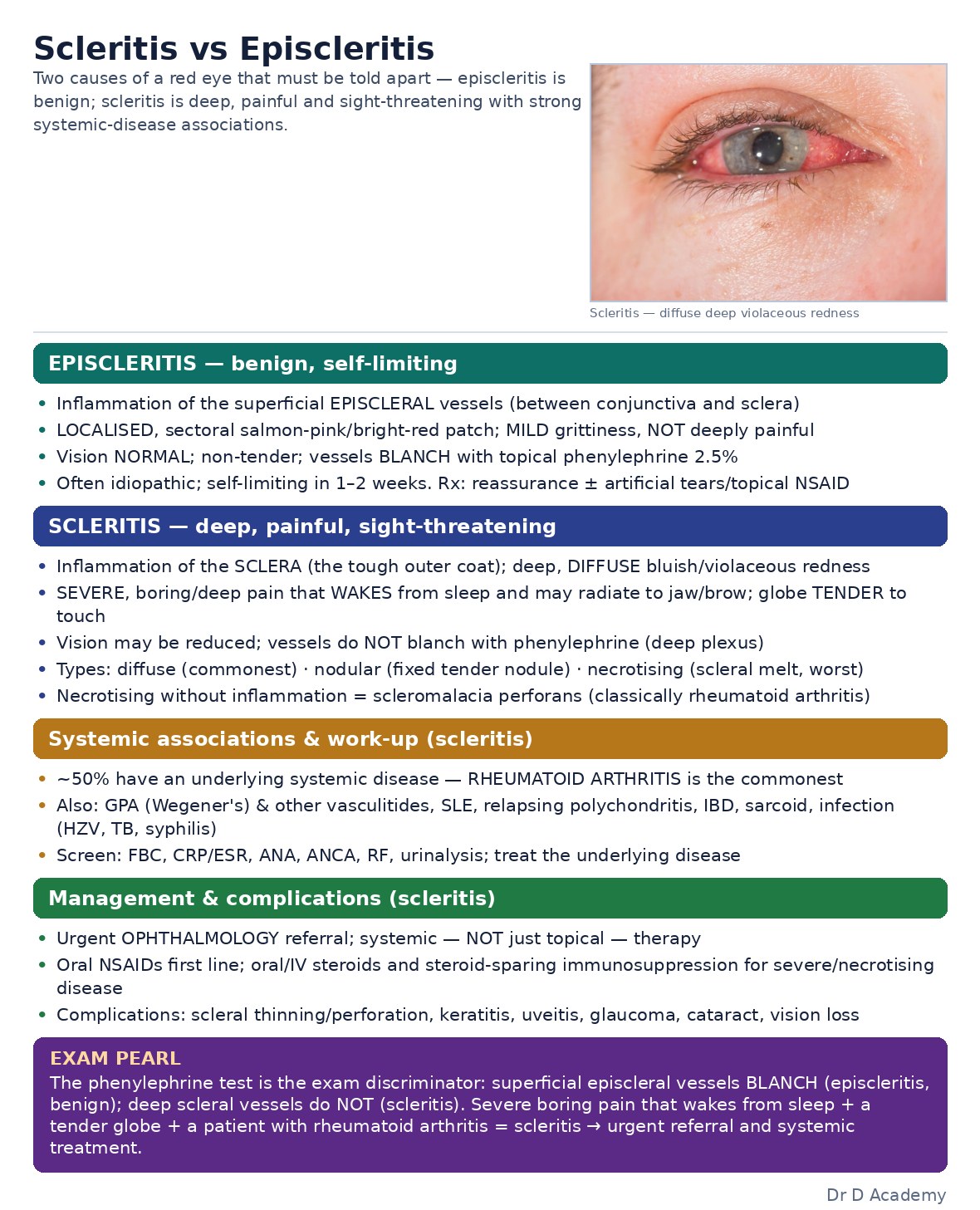
The most severe and destructive form of scleritis, with scleral necrosis and avascular (white, non-perfused) patches on an intensely inflamed sclera. It is strongly linked to systemic vasculitis/autoimmune disease (granulomatosis with polyangiitis, rheumatoid arthritis, relapsing polychondritis) and threatens both the globe (perforation) and life. The painless variant in rheumatoid disease is scleromalacia perforans.
Figures & algorithms
Red flags
- Globe perforation or marked scleral thinning
- Underlying systemic vasculitis (GPA, RA)
- Infectious scleritis after surgery/trauma
- Severe boring pain that disturbs sleep
Assessment
Differential diagnosis
- Diffuse or nodular anterior scleritis (less severe, no necrosis)
- Infectious scleritis (especially Pseudomonas after surgery/trauma)
- Episcleritis (benign, blanches with topical phenylephrine)
Investigations
- Slit-lamp exam: scleral thinning/necrosis and avascular areas (scleral vessels do not blanch with phenylephrine)
- Systemic work-up: ANCA, rheumatoid factor/anti-CCP, ANA, infection screen; involve rheumatology
- Imaging/B-scan for occult posterior involvement or impending perforation
Management
- Refer urgently to ophthalmology and rheumatology — necrotising scleritis signals systemic vasculitis.
- Exclude infectious scleritis (history of surgery/trauma, Pseudomonas) before immunosuppressing.
- Treat non-infectious disease with systemic immunosuppression as the mainstay: high-dose corticosteroid plus a steroid-sparing or biologic agent.
- Topical therapy alone is inadequate; manage pain and protect the globe.
- Arrange scleral patch grafting for actual or impending perforation.
Drugs & doses
High-dose systemic corticosteroid plus an immunosuppressant/biologic (e.g. per rheumatology) — confirm against local policy
Targeted antimicrobial therapy if infectious scleritis is identified — confirm against local policy
Analgesia for severe scleral pain — confirm against local policy
Disposition
Urgent joint ophthalmology and rheumatology care, usually with systemic immunosuppression; admit for perforation risk.
Complications & pitfalls
- Scleral perforation and globe loss
- Severe uncontrolled systemic vasculitis
- Secondary glaucoma, cataract, visual loss
Exam pearls
- Necrotising scleritis is a red flag for systemic vasculitis — hunt for it and involve rheumatology.
- Topical treatment alone will not control it; systemic immunosuppression is needed.
- Scleromalacia perforans is the painless rheumatoid variant.
Educational — confirm all doses against local policy.
Disclaimer: Educational decision support for qualified clinicians and students — not a substitute for clinical judgement, local protocols or a full drug reference. Confirm every dose and contraindication against your formulary before prescribing.