Scleritis & episcleritis (red eye - scleral/episcleral inflammation)
Ocular surface inflammation · Ophthalmology
Physician-written · Verified by three sets of doctors · Reviewed November 2026
Bedside summary
Episcleritis: benign, self-limiting, sectoral superficial redness, mild/no pain, vision normal, blanches with topical phenylephrine. Scleritis: deep, severe boring pain (often waking from sleep, radiating to jaw/brow), violaceous deep injection that does NOT blanch, often associated with systemic autoimmune disease; sight-threatening (necrotising scleritis, posterior scleritis). The distinction drives urgency and workup.
Figures & algorithms
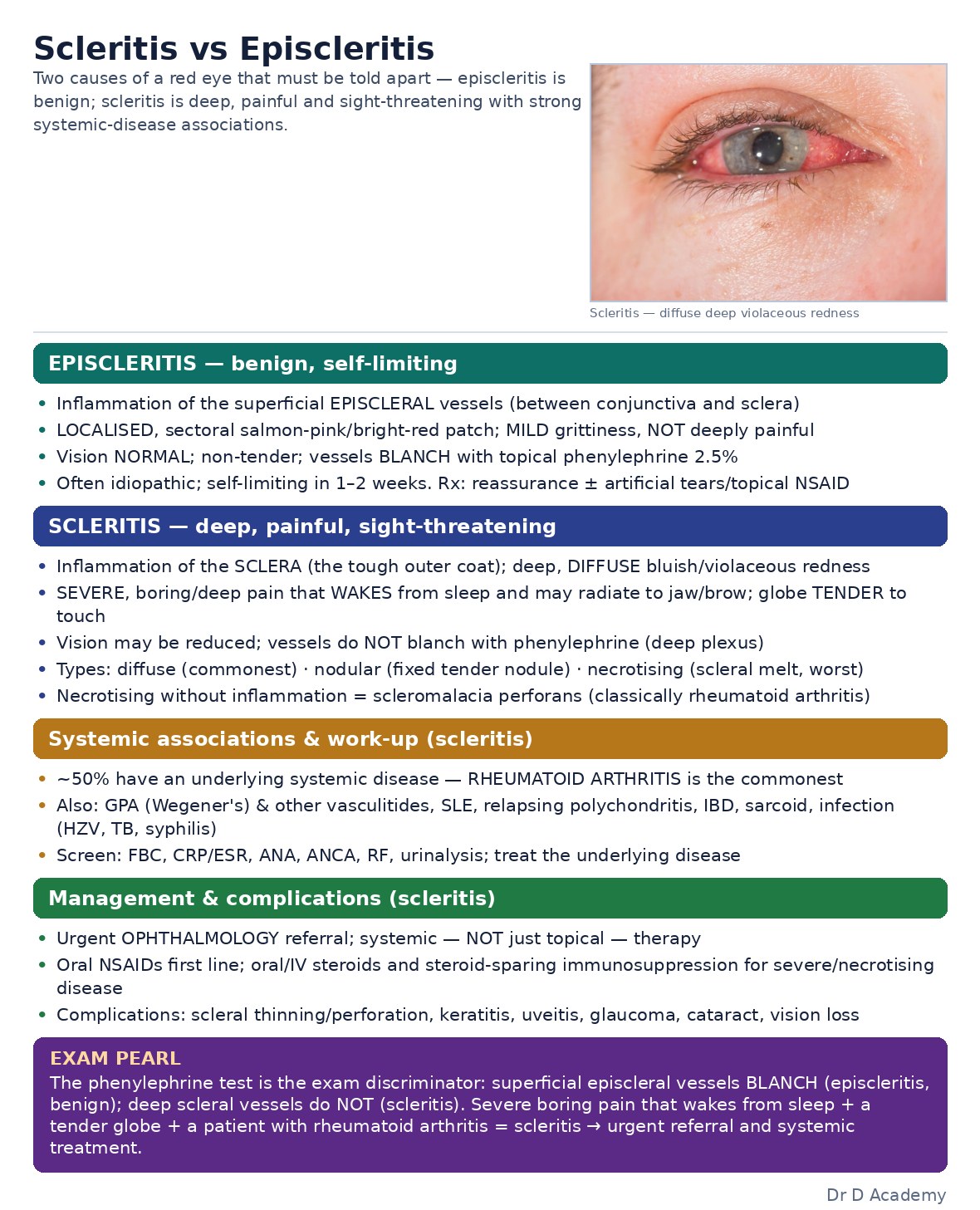
Red flags
- Severe boring eye pain waking from sleep, pain on eye movement - scleritis (not episcleritis)
- Deep violaceous non-blanching injection; scleral thinning/translucency (necrotising)
- Reduced vision, proptosis, restricted motility, disc swelling - posterior scleritis
- Associated systemic features (joints, ENT, renal, respiratory) - vasculitis
Assessment
Differential diagnosis
- Conjunctivitis, subconjunctival haemorrhage
- Anterior uveitis, microbial keratitis
- Acute angle-closure glaucoma
- Scleritis vs episcleritis (phenylephrine blanch test, pain severity)
Investigations
- Slit-lamp; phenylephrine 2.5% test (episcleral vessels blanch; deep scleral vessels do not)
- Assess pain severity, VA, globe tenderness; dilated exam for posterior scleritis/retina
- Scleritis: screen for systemic disease - FBC, CRP/ESR, U&E, urinalysis, RF, ANA, ANCA, ACE, urate; consider CXR; syphilis/TB where relevant
- B-scan ultrasound for posterior scleritis (T-sign)
Management
- 1. Distinguish episcleritis from scleritis (pain character, blanch test, vessel depth).
- 2. Episcleritis: reassure; lubricants +/- topical/oral NSAID; usually self-limiting over 1-2 weeks.
- 3. Scleritis: refer to ophthalmology (urgent/within days); start systemic NSAID, escalate to oral steroids/immunosuppression per severity.
- 4. Investigate scleritis for underlying systemic autoimmune/infective cause (RA, GPA/ANCA vasculitis, relapsing polychondritis, infection).
- 5. Necrotising/posterior scleritis - urgent specialist + systemic immunosuppression; exclude infection before steroids.
- 6. Treat any identified systemic disease with rheumatology input.
Drugs & doses
Episcleritis: lubricants (e.g. hypromellose) PRN; topical NSAID or short topical steroid if troublesome; oral NSAID (e.g. ibuprofen 400 mg TDS) [verify local dose]
Scleritis: oral NSAID first-line (e.g. ibuprofen/naproxen/flurbiprofen) at anti-inflammatory dose [verify local dose]
Oral prednisolone (e.g. 0.5-1 mg/kg/day, taper) for NSAID-refractory or necrotising scleritis - specialist [verify local dose]
Steroid-sparing immunosuppression (e.g. methotrexate, mycophenolate, or biologics such as rituximab) for severe/recurrent - specialist [verify local dose]
Treat infective scleritis with targeted antimicrobials (do not give steroids alone)
Disposition
Episcleritis: discharge with reassurance/NSAID, routine optometry/GP if persistent. Scleritis: urgent ophthalmology + systemic workup; rheumatology co-management; admit necrotising/posterior scleritis.
Complications & pitfalls
- Scleral thinning/perforation (scleromalacia perforans)
- Keratitis, uveitis, secondary glaucoma, cataract
- Permanent visual loss (necrotising/posterior scleritis)
- Underlying systemic vasculitis morbidity
Exam pearls
- Episcleritis blanches with phenylephrine; scleritis does not.
- Pain that wakes the patient and radiates to the jaw/brow signals scleritis.
- New scleritis warrants a systemic autoimmune workup (think ANCA vasculitis, RA).
- Exclude infection before immunosuppressing an inflamed sclera.
Disclaimer: Educational decision support for qualified clinicians and students — not a substitute for clinical judgement, local protocols or a full drug reference. Confirm every dose and contraindication against your formulary before prescribing.