Angioedema differentiation — histaminergic vs bradykinin-mediated
Bedside algorithm to direct angioedema therapy · Allergy / Immunology
Physician-written · Verified by three sets of doctors · Reviewed November 2026
Bedside summary
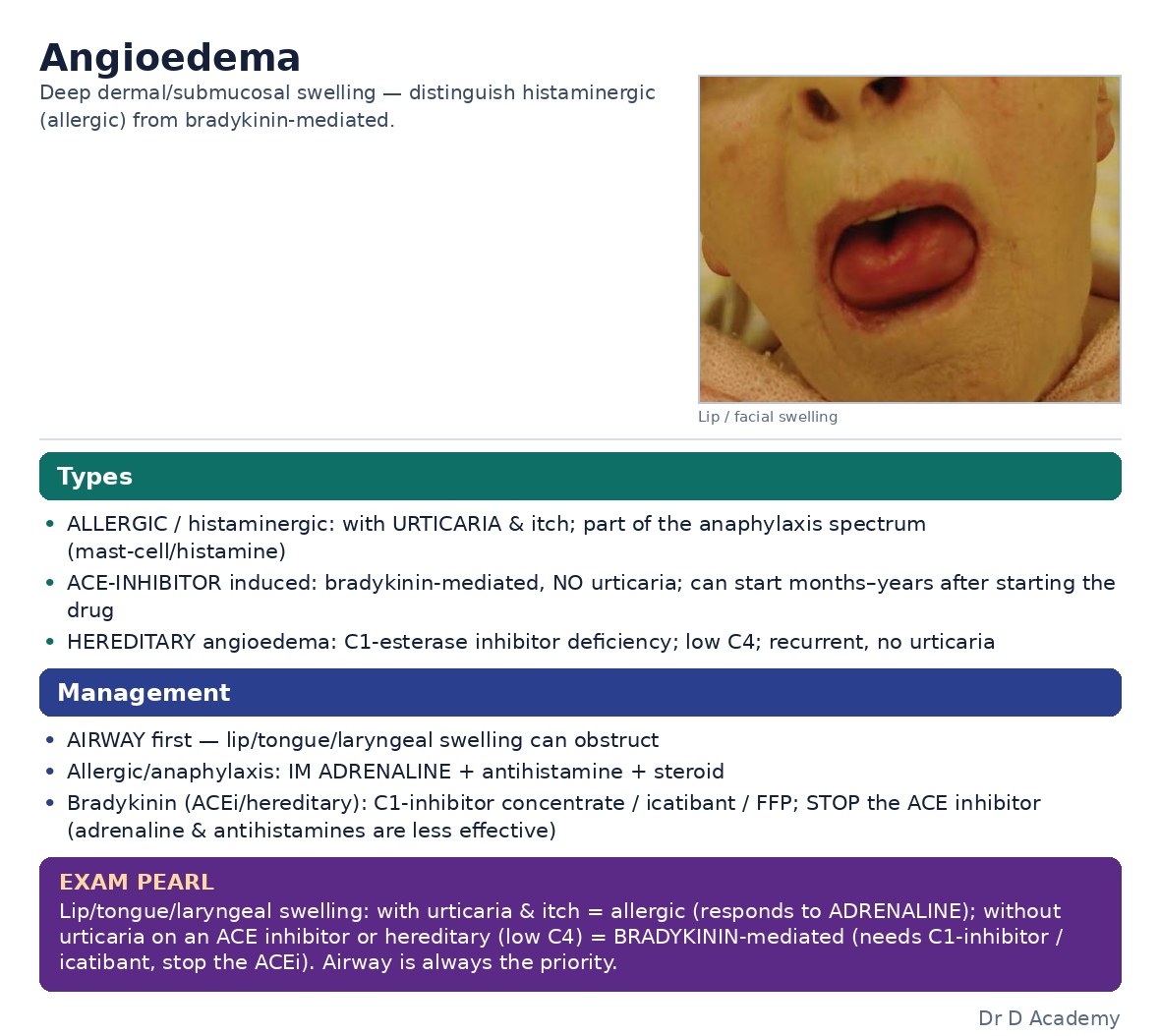
Angioedema divides into histaminergic (mast-cell, responds to adrenaline/antihistamines/steroids) and bradykinin-mediated (ACE-inhibitor, hereditary and acquired C1-INH deficiency, which do not respond to those agents). Rapid classification directs treatment and prevents fatal airway obstruction.
Figures & algorithms
Red flags
- Voice change, dysphagia, drooling or stridor
- Rapidly progressive tongue or laryngeal swelling
- No response to adrenaline/antihistamine/steroid
- Isolated angioedema without urticaria on an ACE-inhibitor
- Known hereditary angioedema with facial/airway involvement
Assessment
Differential diagnosis
- Allergic/histaminergic angioedema (often with urticaria)
- ACE-inhibitor angioedema (bradykinin-mediated)
- Hereditary angioedema (C1-INH deficiency)
- Acquired C1-inhibitor deficiency
- Idiopathic angioedema
Investigations
- Clinical: presence of urticaria/itch (favours histaminergic) vs none (favours bradykinin)
- Response to a trial of antihistamine/adrenaline (bradykinin forms do not respond)
- C4 level (low in bradykinin-mediated C1-INH disorders)
- C1-inhibitor level and function, C1q
- Drug history for ACE-inhibitors, ARBs, gliptins, NSAIDs
Management
- Prioritise airway assessment in every patient — examine tongue, floor of mouth, uvula and larynx
- If urticaria/itch present or recent allergen exposure, treat as histaminergic: adrenaline, antihistamine, steroid
- If no urticaria and on an ACE-inhibitor or with a family history, treat as bradykinin-mediated
- Stop any ACE-inhibitor/ARB immediately and document
- Give bradykinin-targeted therapy (icatibant or C1-INH concentrate) for severe or airway-threatening bradykinin angioedema
- Give a trial of adrenaline even in suspected bradykinin cases if airway is threatened (low risk, may help)
- Secure the airway early (awake fibreoptic / front-of-neck readiness) if progression
- Send complement studies and refer to immunology for confirmation
Drugs & doses
Adrenaline IM — 500 mcg (0.5 mL 1:1000) for histaminergic/airway-threatening angioedema, repeat 5 min
Chlorphenamine — 10 mg IV/IM for histaminergic angioedema
Hydrocortisone — 200 mg IV for histaminergic angioedema
Icatibant — 30 mg SC for bradykinin-mediated (HAE/ACE-I) angioedema
C1 esterase inhibitor concentrate — 20 units/kg IV for C1-INH deficiency attacks
Fresh frozen plasma — 2 units IV if specific agents unavailable
Disposition
Admit any airway-threatened or bradykinin-mediated case for monitoring; discharge mild histaminergic cases with antihistamines and immunology follow-up.
Complications & pitfalls
- Fatal airway obstruction from delayed recognition
- Inappropriate steroid/antihistamine use in bradykinin forms wasting time
- Unnecessary intubation if misclassified
- Recurrence while continuing the culprit ACE-inhibitor
- Missed underlying lymphoproliferative disease in acquired deficiency
Exam pearls
- Itch and wheals favour histaminergic; their absence with ACE-inhibitor use or family history favours bradykinin
- Bradykinin angioedema does not respond to adrenaline, antihistamines or steroids — give icatibant or C1-INH
- A low C4 is a useful screening clue to C1-inhibitor disorders
- When uncertain and the airway is threatened, treat for both and prioritise the airway
Disclaimer: Educational decision support for qualified clinicians and students — not a substitute for clinical judgement, local protocols or a full drug reference. Confirm every dose and contraindication against your formulary before prescribing.