Hereditary angioedema — long-term prophylaxis & peri-procedural cover
Preventing attacks and covering surgery/dental work in HAE · Allergy / Immunology
Physician-written · Verified by three sets of doctors · Reviewed November 2026
Bedside summary
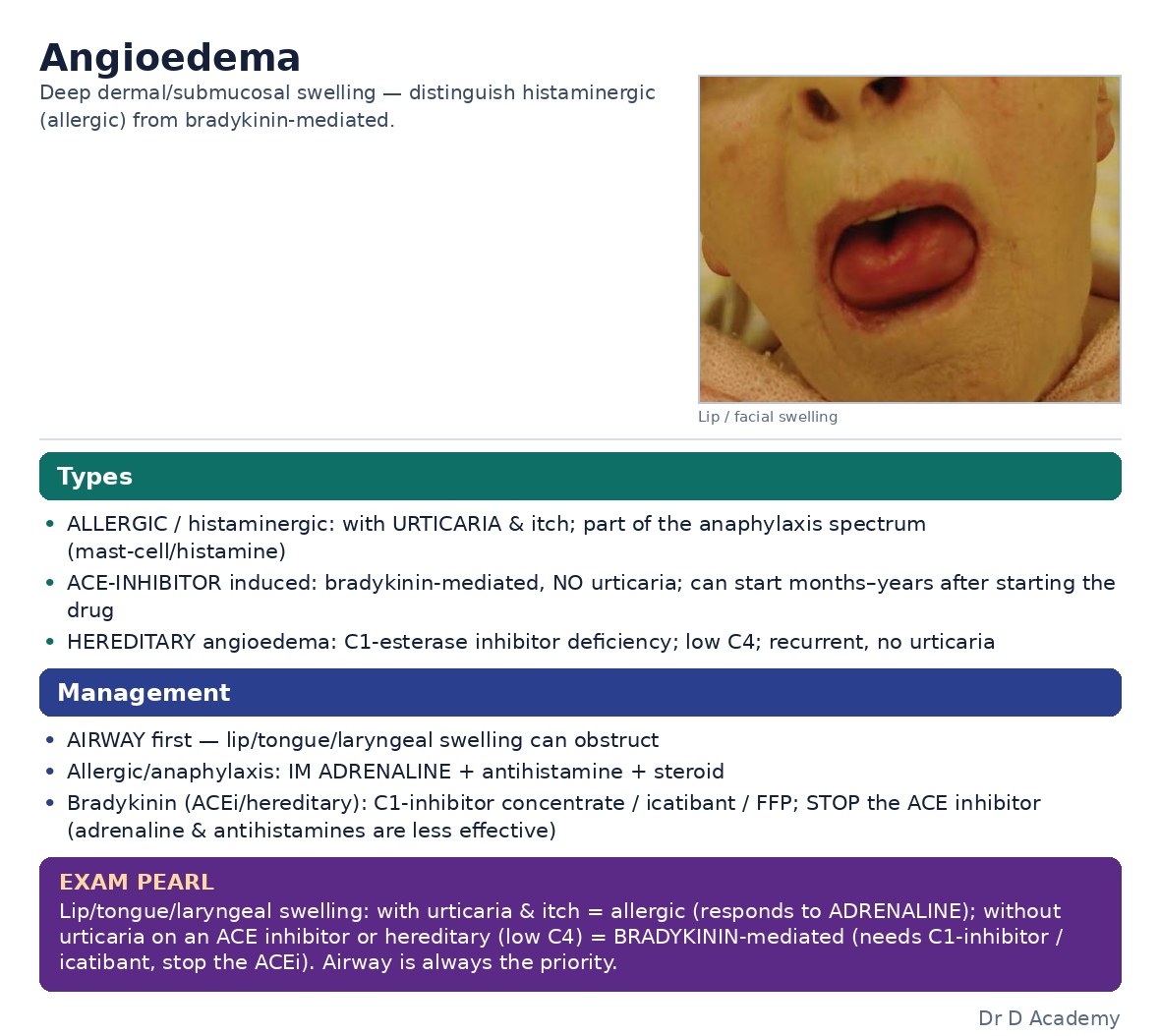
Patients with hereditary angioedema (C1-inhibitor deficiency) benefit from long-term prophylaxis when attacks are frequent or severe, and require short-term prophylaxis before procedures that can trigger airway attacks. Modern prophylaxis uses C1-INH concentrate, lanadelumab or berotralstat rather than attenuated androgens.
Figures & algorithms
Red flags
- Laryngeal attack with voice change or stridor
- Breakthrough attacks despite prophylaxis
- Planned airway/dental surgery without arranged cover
- New low C1q suggesting acquired deficiency / lymphoproliferation
- Pregnancy (androgens contraindicated; attack frequency may change)
Assessment
Differential diagnosis
- Acquired C1-inhibitor deficiency
- ACE-inhibitor angioedema
- Histaminergic/idiopathic angioedema
- Normal C1-INH HAE (factor XII / plasminogen mutations)
- Chronic urticaria with angioedema
Investigations
- C4 (low between and during attacks)
- C1-inhibitor antigenic level and function
- C1q (normal in hereditary, low in acquired)
- Genetic testing (SERPING1) where diagnosis unclear
- Baseline attack frequency and severity log to guide prophylaxis
Management
- Confirm diagnosis with C4 and C1-INH level/function before committing to prophylaxis
- Ensure every patient has on-demand therapy (icatibant or C1-INH) and a written action plan
- Offer long-term prophylaxis if attacks are frequent, severe or airway-involving
- Prefer C1-INH concentrate, lanadelumab or berotralstat over attenuated androgens
- For procedures with airway/orofacial trauma risk, give short-term prophylaxis before the procedure
- Arrange on-demand C1-INH/icatibant to be available during and after any procedure
- Avoid ACE-inhibitors, ARBs and oestrogen-containing contraceptives
- Refer to a specialist HAE/immunology centre for ongoing management and self-administration training
Drugs & doses
C1 esterase inhibitor concentrate — 20 units/kg IV for acute attacks; 1000 units IV short-term pre-procedure prophylaxis (within 6 h of procedure)
Lanadelumab — 300 mg SC every 2 weeks for long-term prophylaxis
Berotralstat — 150 mg orally once daily for long-term prophylaxis
Icatibant — 30 mg SC as on-demand rescue
Tranexamic acid — 1 g orally three times daily as weak short-term prophylaxis when specific agents unavailable
Danazol — 200 mg orally daily (attenuated androgen, now second-line due to adverse effects)
Disposition
Manage in a specialist HAE service with a self-administration plan; ensure pre-procedure prophylaxis is arranged before any elective airway/dental work.
Complications & pitfalls
- Fatal laryngeal obstruction during untreated attacks
- Androgen adverse effects (virilisation, dyslipidaemia, hepatic adenoma)
- Procedure-triggered attacks without prophylaxis
- Recurrent abdominal attacks mistaken for surgical abdomen
- Reduced quality of life and anxiety
Exam pearls
- Short-term prophylaxis is essential before dental and airway procedures even in well-controlled patients
- Keep on-demand therapy available regardless of prophylaxis — breakthrough attacks still occur
- Oestrogens and ACE-inhibitors provoke attacks and should be avoided
- Androgens are now largely superseded by C1-INH, lanadelumab and berotralstat
Disclaimer: Educational decision support for qualified clinicians and students — not a substitute for clinical judgement, local protocols or a full drug reference. Confirm every dose and contraindication against your formulary before prescribing.