Difficult-airway trolley readiness
Airway safety · Anaesthesia & Perioperative
Physician-written · Verified by three sets of doctors · Reviewed November 2026
Bedside summary
A standardised, stocked and regularly checked difficult-airway trolley gives immediate access to rescue equipment during an airway crisis, with contents arranged to follow the airway plan.
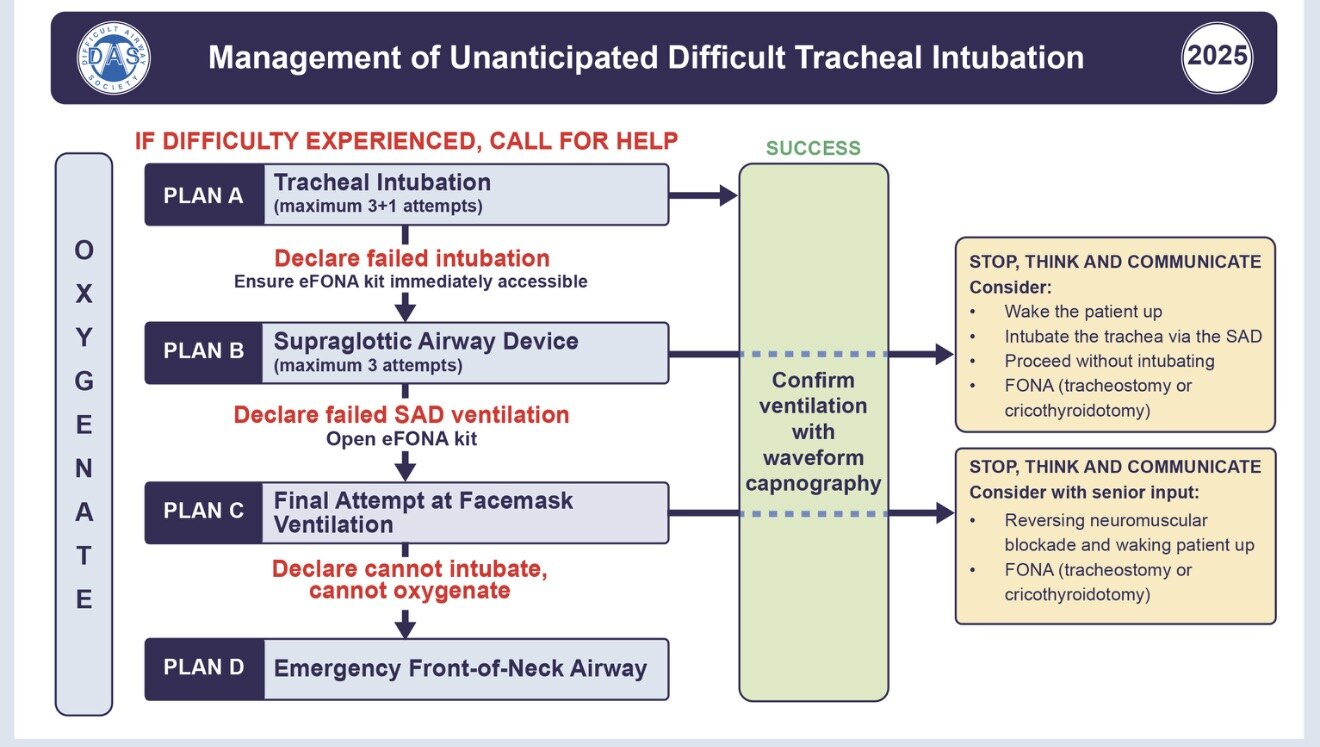
Figures & algorithms
Assessment
Investigations
- Daily stock and expiry check
- Videolaryngoscope charged and working
- Front-of-neck access kit present
- Second-generation supraglottic airways available
- Fibreoptic scope and exchange catheters ready
Management
- Standardise the trolley contents across the organisation
- Check and restock the trolley daily
- Arrange equipment to follow the difficult-airway plan
- Include a range of blades, videolaryngoscopes and bougies
- Stock second-generation supraglottic airways
- Include a scalpel-bougie-tube front-of-neck access kit
- Ensure staff know the location and contents
Drugs & doses
No drugs — equipment readiness
Scalpel, bougie and size-6 tube for front-of-neck access
Videolaryngoscope and second-generation SADs
Disposition
Theatre / ED / ICU; immediately accessible.
A checked, standardised trolley arranged to match the airway plan is central to managing the unanticipated difficult airway (DAS guidelines).
Disclaimer: Educational decision support for qualified clinicians and students — not a substitute for clinical judgement, local protocols or a full drug reference. Confirm every dose and contraindication against your formulary before prescribing.